In this essay
The classroom, teacher and pupils in this story are imaginary. The historical record presented through October 2026 is documented in the notes. Events after that date, including the condition of the world in 2300, are deliberately left as fiction or open questions.
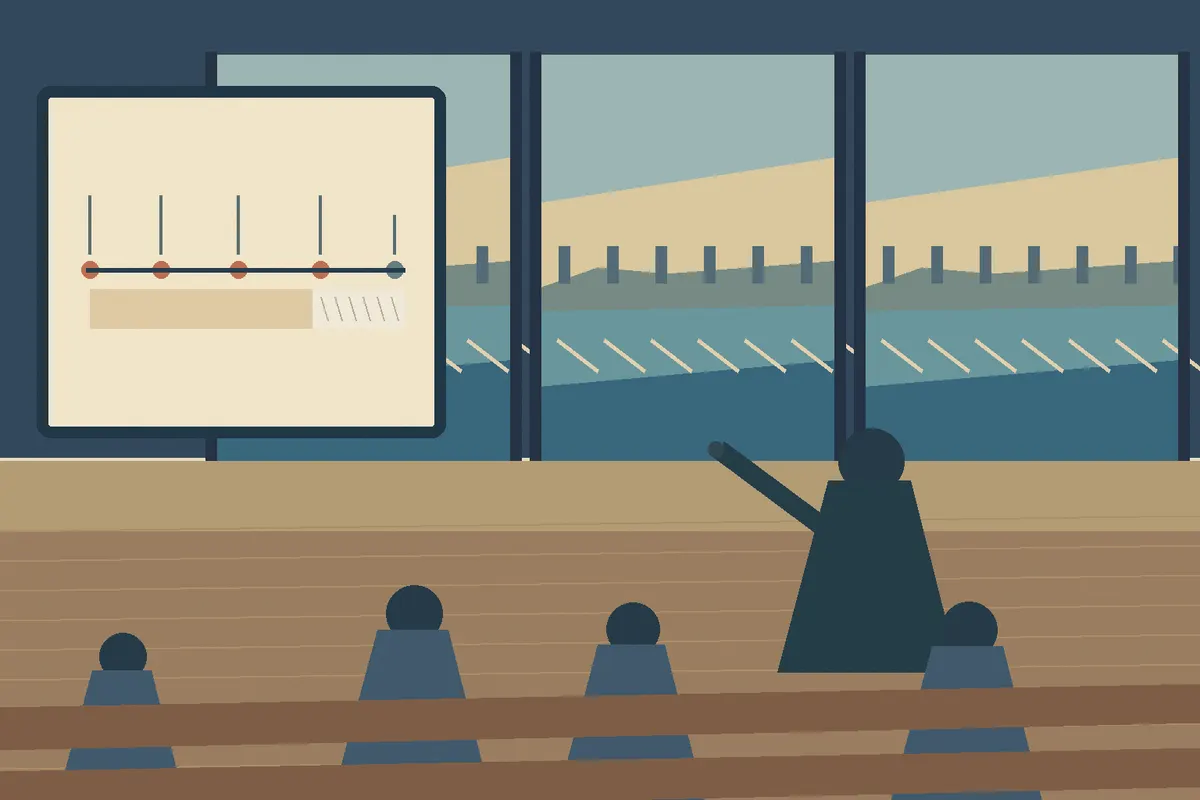
The classroom window looked towards water. There was a broad band of reeds, a footpath on higher ground and, beyond it, the roofs of a settlement whose oldest buildings were younger than the school.
A pupil had asked why. That was how the lesson began.
On the wall appeared a heading: Climate Change, 1850–2050.
'Why does the chapter end in 2050?' asked Mira.
'Because historians have to put chapter boundaries somewhere,' said their teacher, Anika. 'Nothing stopped changing at midnight on 31 December. We choose a period because it helps us see a pattern. The pattern does not ask our permission.'
'Is that why our town is here and not beside the old harbour?' asked Samir.
'It may be connected. But today we are not going to turn a map into a simple answer. Today we are going to investigate what people knew, what they could do, and what they chose.'
Lesson one: they discovered the problem before they gave it a name
'Put up the first date,' said Anika.
'1850,' replied Lio, who liked answers he could check.
'Good. Roughly the beginning of the reference period used in many modern warming comparisons. But we need to travel back twenty-six years first.'
A sketch of Joseph Fourier appeared: 1824. He had reasoned that the Earth would be colder without the warming influence of its atmosphere. In 1856 Eunice Foote experimented with gases and heat; John Tyndall's laboratory work in 1859 demonstrated how gases including water vapour and carbon dioxide absorb infrared radiation. In 1896 Svante Arrhenius calculated how changing carbon dioxide might alter temperature.[1]
'People knew in 1896?' asked Mira.
'They had important parts of the physics. They did not have a modern global observing system, nor a trustworthy description of every consequence. Do not confuse discovering a mechanism with possessing a complete forecast.'
'But it wasn't magic,' said Lio.
'No. It was chemistry, physics, measurement and then a great deal of argument. In 1938 Guy Callendar assembled temperature and carbon dioxide evidence and argued that human activity was already warming the planet.[1:1] He was not the last person to make that argument.'
'Were they frightened?'
'Some were worried. Some thought warming might be useful. Some disagreed about the size of the effect. People in the past were not one enormous person with one opinion. That is the first mistake to avoid in history.'
The graph nobody could vote against
The wall changed. A fine jagged line climbed, with little annual teeth, across the decades.
'What are the teeth?' asked Samir.
'Seasonal changes. Plants absorb and release carbon dioxide. The important thing is the direction of the whole line.'
In 1958 Charles David Keeling began precise measurements of atmospheric CO₂ at Mauna Loa. The early reading was about 315 parts per million. By September 2026, NOAA reported a monthly average of 426.07 ppm at that station.[2]
'That looks like a staircase with a broken handrail,' said Mira.
'A vivid description. Now notice something else: there is no election-day dip. It does not know the name of the prime minister or who won a television debate.'
'Could they see it rising every year?'
'Yes. They also developed satellite observations, global temperature records, ocean measurements and increasingly sophisticated models. The argument did not rest on one instrument on a mountain.'
'Why did the line not stop when they agreed it was bad?'
'Because understanding a problem and changing an energy system are very different accomplishments.'
The warnings were on the desks
Anika selected four documents from the archive. Their dates appeared beside them.
1965. A report to the president of the United States warned that fossil-fuel carbon dioxide could cause significant climatic change. 1979. The Charney assessment estimated about 3°C of eventual equilibrium warming from doubled atmospheric CO₂, with a range of 1.5–4.5°C. 1990. The first IPCC assessment described increasing greenhouse gases from human activity and expected warming. 2023. The IPCC synthesis stated unequivocally that human activities, principally greenhouse gas emissions, had caused global warming.[3][4]
'Four warnings?' said Lio.
'Four landmarks. There were many more papers, observations and debates between them.'
'Why did the warning get stronger?'
'The evidence improved. That is what science is supposed to do. It would be bad history to claim the people of 1965 possessed the same evidence as the people of 2023.'
'And just as bad to say the people of 2023 knew nothing,' said Mira.
'Exactly.'
Samir raised his hand. 'If a report was given to a president, why didn't the president just order everyone to stop?'
'Would you be willing to make that order? At that time, transport, heating, farming, manufacturing and jobs depended heavily on fossil fuels. A sudden prohibition would have consequences of its own. A responsible transition required alternatives, infrastructure, money and time.'
'They had time,' said Mira.
'They had more time earlier than they did later. That's a fair observation.'
The age of promises
The next images were not of laboratories. They showed conference halls, voting chambers and people signing documents.
In 1988 the Intergovernmental Panel on Climate Change was established. In 1992 governments adopted the UN Framework Convention on Climate Change. Kyoto followed in 1997, with binding targets for some industrialised countries. The Paris Agreement was adopted in 2015, establishing a framework in which countries put forward national contributions and return to them in five-year cycles.[5]
'Was the Paris Agreement a law?' asked Lio.
'It was an international treaty with legal obligations, including to prepare and communicate national climate plans. That is not the same as a world government ordering every country to meet one compulsory emissions number. Words like "agreement" can conceal the difference.'
'It sounds as if they spent a lot of time agreeing to agree,' said Samir.
'Some of the negotiations created real systems of measurement, investment and accountability. Some commitments were insufficient. Both statements can be true.'
'Why did they call it a victory then?' asked Mira.
'Because obtaining a broad agreement among states with different interests is difficult. Whether that diplomatic victory was enough for the physical problem is a separate question.'
The teacher put two columns on the wall: What was promised and What changed.
'For today's exercise, you may not put the same evidence in both columns.'
The word 'we' caused an argument
'Why didn't they give up their cars?' asked a pupil at the back.
'Who is "they"?' Anika asked.
'People in the old world.'
'An oil company director? A farmer who couldn't afford a different tractor? An engineer designing an electric grid? A child who had never been on an aeroplane? A person without reliable electricity? Be careful with a pronoun that makes billions of unequal lives look interchangeable.'
Anika brought up a figure from the IPCC's 2022 mitigation assessment. It estimated that the highest-emitting tenth of households, ranked by per-person emissions, accounted for 34–45% of global consumption-based household greenhouse gas emissions; the bottom half accounted for 13–15%. Those are shares of household consumption emissions, not all emissions from every source.[6]
'But did the companies know?' asked Mira.
'Some did work of remarkable quality. A published analysis of Exxon and ExxonMobil scientists' projections from 1977–2003 found that most closely tracked subsequent warming. It also described contradictions between those scientific findings and public company communications.[7] One should examine the evidence and the particular organisations, not treat every worker and every firm as identical.'
'Would you call it lying?' asked Samir.
'Historians must establish what was said, what was known, by whom, and when. You may reach a judgement. I will not do your judging for you.'
'You just made the lesson harder.'
'That,' said Anika, 'is generally what evidence does.'
The years we cannot know from here
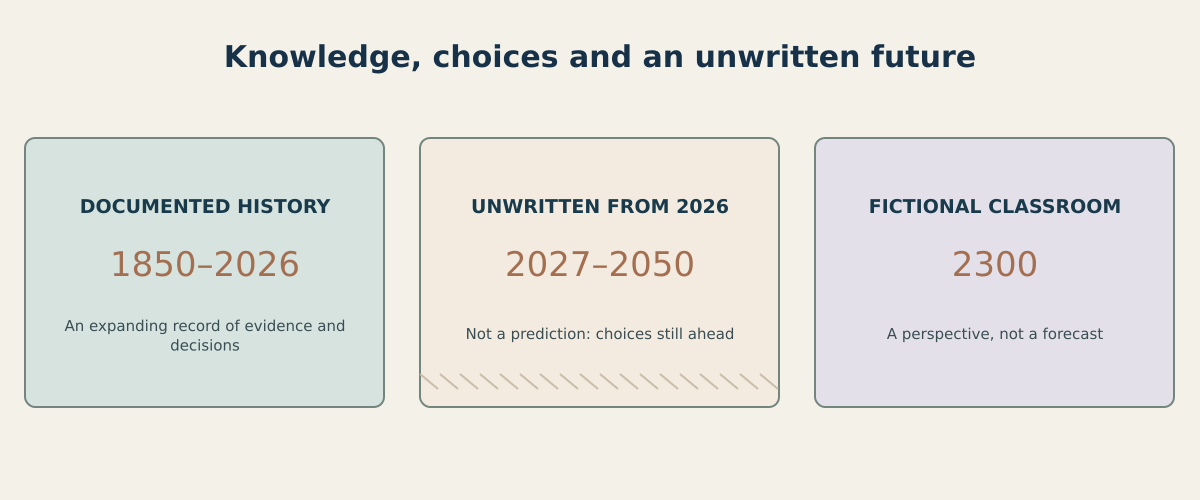
A strip of the wall remained unfilled: 2027–2050.
'Are the records missing?' asked Lio.
'No,' said Anika. 'This is a special exercise. Imagine you are standing in October 2026. You can read everything written up to that point. You cannot honestly write the next twenty-four years as though they have already happened.'
On one side appeared the IPCC's 2023 assessment: deeper emissions cuts would limit future warming; additional warming would increase risks.[4:1] On the other appeared UNEP's 2025 analysis, which estimated substantially different temperature outcomes for current policies and for pledges being fully implemented.[8]
'Which one happened?' asked Mira.
'That is not the question available to somebody in 2026. Their task was to choose while the future was unresolved.'
'And did they?' Samir persisted.
'In our imagined classroom there might be a complete archive of what came next. But the author of this exercise lives in 2026. We won't smuggle invented events into historical evidence merely because the story is set in 2300.'
'That's cheating on a history test.'
'Precisely.'
What can a distant child inherit?
The wall showed the outline of a coastline at several dates, all clearly marked as scenarios, not maps of the pupils' actual town.
'Could this coastline have changed?' asked Samir.
'Yes. The IPCC's physical-science assessment projects that the sea will keep rising for centuries to millennia. It includes possible global mean sea-level outcomes extending to 2300, with large differences between emissions scenarios and substantial uncertainty about ice sheets.[9] It does not provide us with a street-by-street map of where this fictional school must stand.'
'What about animals?' asked Mira. 'My grandmother says there used to be different birds along the water.'
'Your grandmother is a character in this story, so her recollection is not evidence either. But biodiversity loss is a real concern. The climate assessments document risks to ecosystems alongside risks to human livelihoods.[10] A species is not merely a line in a ledger marked "useful to humans".'
'Would we be safer than they were?'
'I cannot promise that. Nor can I pretend the future is only ruin. Every avoided fraction of warming matters; every good water system, sound building and healthy habitat matters. History is not a contest between inevitable paradise and inevitable extinction.'
Lio studied the blank part of the timeline. 'So there could have been people in 2026 who made sensible decisions, and others who didn't.'
'Undoubtedly there were people making different kinds of decisions. Whether each one was sensible is a question you would investigate with evidence.'
The last question
'Can we blame them?' asked Mira.
There was a pause, long enough for the sound of wind outside to reach the room.
'You may criticise choices,' said Anika. 'You may be angry about damage. But if you want to make a serious judgement, find out who knew, who had power, who benefited, who warned, who tried, and who had no real choice. You will learn very little by announcing that two hundred years of people were all fools.'
Samir looked towards the water.
'What I don't understand is why they kept asking whether they could afford to do anything. What was the alternative supposed to cost?'
Anika did not answer at once.
'Write that down,' she said. 'That is a good history question.'
The bell sounded. The pupils closed their notebooks. Mira stayed behind.
'One more thing. If people in 2026 could see the future as clearly as we can see their past, would they have acted differently?'
'Perhaps,' said Anika. 'But if people waited for certainty before doing anything difficult, there would never be much history worth studying.'
Mira nodded, then stopped at the door.
'Are there children in the year 2600 studying us?'
'If there are,' said Anika, 'I hope we have left them an awkwardly short lesson.'
Historical and scientific sources
American Institute of Physics, Spencer Weart, The Discovery of Global Warming: Timeline (updated April 2026), covering Fourier (1824), Foote (1856), Tyndall (1859), Arrhenius (1896) and Callendar (1938). Historical timeline; see also NASA's summary of the evidence and early experiments. ↩︎ ↩︎
NOAA Global Monitoring Laboratory, Trends in Atmospheric Carbon Dioxide, Mauna Loa observations begun March 1958; September 2026 monthly mean 426.07 ppm. These are station measurements, not global annual means. NOAA data. ↩︎
President's Science Advisory Committee (1965), Restoring the Quality of Our Environment, atmospheric carbon dioxide appendix; National Research Council (1979), Carbon Dioxide and Climate: A Scientific Assessment (Charney report); IPCC (1990), First Assessment Report, Working Group I. 1965 original excerpt · Charney report · IPCC 1990 report. ↩︎
IPCC (2023), Climate Change 2023: Synthesis Report, Summary for Policymakers, A.1 and B.1–B.3. Headline statements. ↩︎ ↩︎
UNFCCC, History of the Convention and Key aspects of the Paris Agreement, for the 1992 convention, Kyoto and Paris mechanisms; IPCC History. UNFCCC overview · Paris provisions · IPCC history. ↩︎
IPCC (2022), Climate Change 2022: Mitigation of Climate Change, Summary for Policymakers, B.3.4. Household-consumption emission shares, not all global emissions. Assessment. ↩︎
Supran, G., Rahmstorf, S. & Oreskes, N. (2023), “Assessing ExxonMobil's global warming projections,” Science 379, eabk0063. DOI · Abstract. ↩︎
United Nations Environment Programme (2025), Emissions Gap Report 2025: Off Target. The warming outcomes are conditional projections made at the report's publication date. Report. ↩︎
IPCC (2021), Climate Change 2021: The Physical Science Basis, Summary for Policymakers B.5.3–B.5.4 and Technical Summary on projections through 2300. Summary · Technical Summary. ↩︎
IPCC (2022), Climate Change 2022: Impacts, Adaptation and Vulnerability, Summary for Policymakers, ecosystems and biodiversity sections. Assessment. ↩︎