In this essay
- Collapse begins in the ordinary
- The supermarket is connected to somebody else’s weather
- Water and heat can eat away at a society
- The sea is not a spare food cupboard
- What fails next?
- The people who leave—and the people who cannot
- The politics are not pre-written
- There is no country called “elsewhere”
- Damage is not destiny
- References
Civilisation does not have to disappear everywhere for the future to become appalling.
There can still be functioning airports, stock exchanges and universities while other places lose reliable water, affordable food and any reasonable expectation that next year will be better. A person can watch a disaster unfold on a perfectly good phone. The existence of the phone tells us remarkably little about the existence of a tolerable life.
That is the future I think deserves far more attention: a world in which increasingly severe climate disruption helps some societies fracture while others carry on, adapt, profit or retreat behind their borders. We keep asking whether humanity will survive. We should spend more time asking what survival will mean, and who gets to participate.
Collapse begins in the ordinary
The word collapse is so theatrical that it can make a serious discussion almost impossible. It summons an empty skyline, overturned cars and the last surviving family. Anything short of that can then be dismissed as alarmism.
I am using it here to mean the prolonged failure of the institutions and services that make a decent life possible. A country need not vanish from the map. Its government might retain an embassy and a national anthem while becoming unable to keep significant parts of its population fed, safe and supplied with water.
This is an argument about a danger we should take seriously, not a timetable of countries destined to fail.
The IPCC estimated in 2022 that 3.3–3.6 billion people lived in highly climate-vulnerable settings. It found large differences within and between regions, shaped by factors including poverty, inequality and governance.[1]
That last distinction matters. A national average can conceal two entirely different worlds. In an imagined city hit by the same heatwave, one household buys cooling and backup electricity; another chooses between paying for power and buying food. They share the weather. They do not share the consequences.
We should stop treating the continued existence of national institutions as proof that society is working. A hospital can remain open while becoming inaccessible. Food can remain on sale while becoming unaffordable. Water can exist in a reservoir while failing to reach the people who need it.
For the person excluded, the statistical survival of the system is a cold comfort.
The supermarket is connected to somebody else’s weather
Food is where the distance between a climate graph and an ordinary life becomes very short.
International trade is an extraordinary piece of collective insurance: a poor harvest in one place can be covered by production elsewhere. The awkward question is what happens when several important producers have a bad year together.
Tigchelaar and colleagues modelled maize production in warmer climates and found substantially greater risks of simultaneous production shocks in major exporting countries. Their analysis isolated temperature effects and did not assume future gains in crop heat tolerance. It was a warning about a vulnerability, not a prediction of the exact harvests the world will get.[2]
A separate 2023 study by Kornhuber and colleagues examined harvest losses associated with strongly meandering jet streams. It found that the studied models often underestimated the local weather extremes and crop losses associated with these circulation patterns. The authors identified a blind spot in assessments of simultaneous harvest risk.[3]
Put those findings together and the sensible response is to take the possibility of connected failures seriously. It is absurd to make the opposite assumption simply because the machinery is complicated.
Imagine two importing countries bidding for a smaller exportable surplus. The wealthier government can pay more, subsidise essentials or absorb a financial loss. The poorer government faces harder choices. In that situation, a harvest shortfall becomes a question of purchasing power before it becomes a question of whether the planet can physically grow enough food.
Then imagine the households inside those countries. A higher food bill can mean a postponed holiday for one family and missed meals for another. Calling both outcomes an economic impact is technically tidy and morally useless.
The risk is not that every farm stops working on the same morning. It is that repeated shocks make the promise of affordable food less dependable, and that the people with the smallest reserves pay first.
Water and heat can eat away at a society
Water is equally unforgiving. You cannot negotiate with a dry tap, although plenty of negotiations determine whose tap runs dry first.
The IPCC’s water assessment distinguishes physical scarcity from water insecurity. The latter also involves access, infrastructure, quality and governance. Climate change is worsening water-related vulnerabilities, but demand and management can also be decisive. The same assessment finds that water-related risks grow with additional warming.[4]
That gives us a more useful picture than a map coloured red wherever rainfall declines. A society needs institutions capable of maintaining pipes, managing competing demands and protecting access when supplies are strained. It also needs the money and public trust to carry out difficult decisions.
Consider a hypothetical farming region caught between falling water availability and rising demand. Pumping more may postpone a crisis. Cutting agricultural allocations may protect cities but destroy livelihoods. Delaying the argument until the shortage becomes an emergency makes every choice uglier. None of those choices can be settled by announcing that people ought to be more resilient.
Heat adds another pressure. Research by Parsons and colleagues shows how warming can reduce the hours available for safe heavy work. Moving work to cooler times helps, but that option becomes less effective as those hours also warm.[5]
An economy is made of people doing things. The person repairing a road, harvesting a crop or building a house cannot simply move the entire task into an air-conditioned office. A society that needs more repair and protection while exposing the people doing that work to increasing heat has a difficult problem on its hands.
The response has to reach beyond individual endurance. Working conditions, reliable power, shaded streets, housing and public services belong in the same conversation as temperature. Telling a worker to adapt while leaving the cost entirely with them is an instruction to suffer more efficiently.
The sea is not a spare food cupboard
Even the ocean refuses to behave like an unlimited reserve we can turn to when things become difficult on land.
Carbon dioxide absorbed by seawater changes its chemistry, reducing the availability of carbonate ions used by many organisms to build shells and skeletons. Ocean acidification therefore creates problems for organisms including oysters, clams and corals. This is a direct consequence of adding CO₂ to the atmosphere, alongside its warming effect.[6]
We do not need to imagine the sudden disappearance of all marine life to understand the concern. A fishing or shellfish community depends on particular organisms, in particular waters, supporting a livelihood at a particular cost. A disruption that looks modest in a planetary average can be enormous at that scale.
That is the recurring mistake in cheerful abstractions about human adaptability. They skip over the people whose familiar world must be dismantled before somebody, somewhere, can demonstrate that the species has adjusted.
What fails next?
The real danger sits in the connections. A damaged harvest is one problem. A damaged harvest arriving alongside water stress, dangerous heat and a government already struggling to fund public services is a different problem.
The IPCC describes risks that combine and spread across sectors and regions, including through damaged infrastructure.[1:1] We need to think in those terms because people live inside connected systems, not inside the separate chapters of an assessment report.
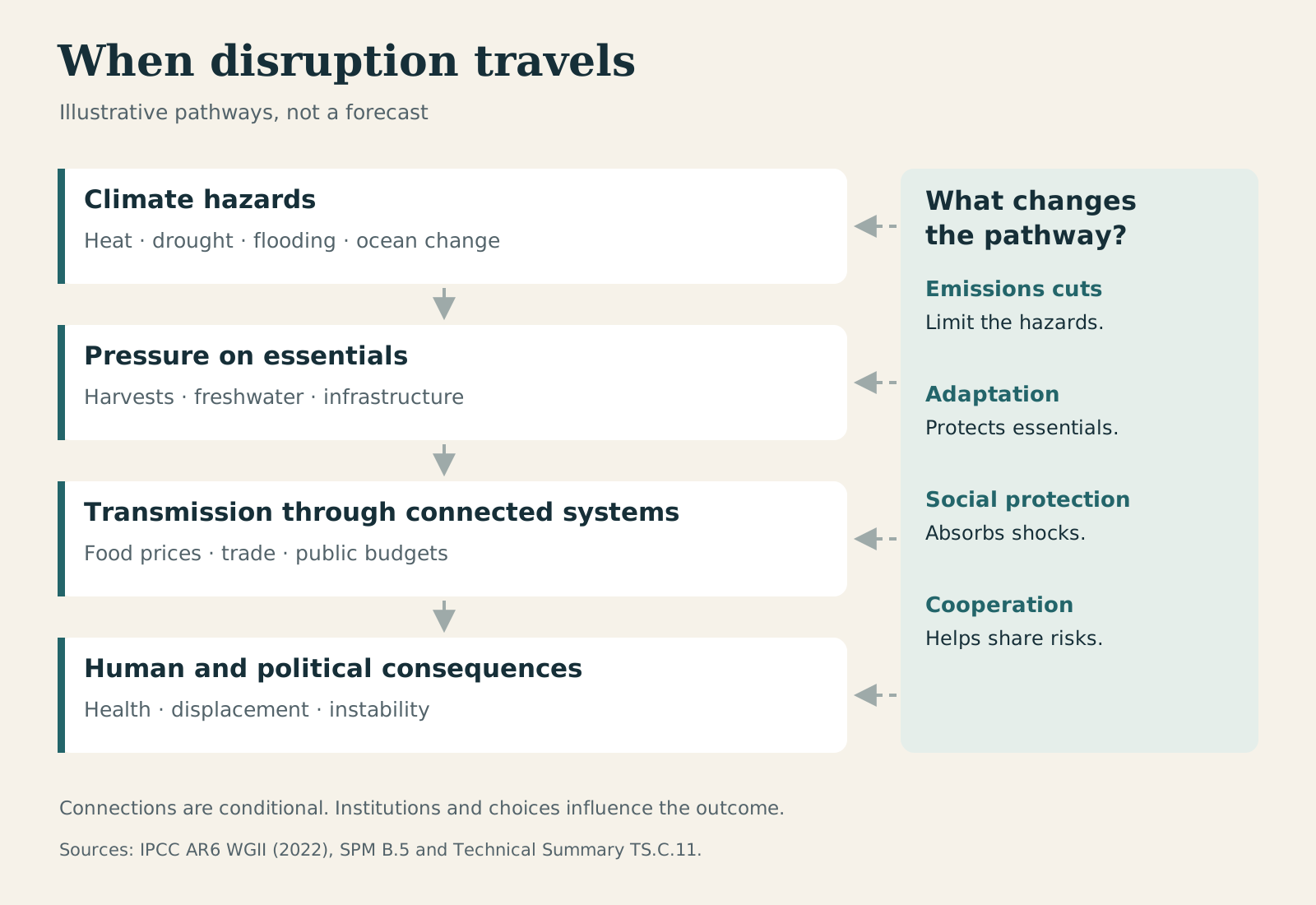
Imagine a sequence rather than a single catastrophe. A crop loss cuts income. A household takes on debt. Its next setback arrives before it has recovered. Meanwhile, repairs consume public money that would otherwise improve protection. Each blow makes the next harder to absorb.
There are opportunities to interrupt such a sequence: functioning services, savings, cooperation, preparation. There are also opportunities to make it worse. That is why I find descriptions of climate change as a collection of isolated environmental problems so inadequate. The political and economic organisation of a society is part of the story from the beginning.
The people who leave—and the people who cannot
When a livelihood becomes untenable, moving may be a sensible response. Yet climate migration is too often described as though every affected person will immediately head towards a wealthy country’s border.
A meta-analysis by Hoffmann and colleagues found that environmental hazards affect migration in ways that depend on local conditions. The movements studied were primarily internal or towards low- and middle-income countries. Income and conflict helped explain differences in the response.[8]
There is another group that the border panic tends to erase: people who cannot afford to leave. The UK Government Office for Science’s Foresight project warned that environmental change can destroy the resources people would need to move. It also identified planned migration as a possible way to reduce vulnerability.[7:1]
We therefore need to picture families staying, families moving nearby, people finding better opportunities, and people becoming stranded. The reality is much more human than an arrow sweeping across a map.
My fear is that wealthy societies will interpret these pressures mainly as a security problem: how to keep other people’s desperation at a manageable distance. That is a political danger, not a law of climate science. It is also a choice we ought to recognise before it hardens into the unquestioned purpose of government.
If your preferred solution to a threatened community is to make sure its members cannot reach you, you have not solved their problem. You have decided where you want to watch it from.
The politics are not pre-written
It is tempting to draw a straight line from drought to hunger to migration to war. That line is too neat to be trustworthy, and it lets human decision-makers off the hook.
In a structured assessment of expert views, Mach and colleagues found agreement that climate had affected conflict within countries. But socioeconomic development and state capabilities were judged substantially more influential, and the mechanisms remained uncertain.[9]
That finding matters because a society under pressure still has choices. It can share losses, invest in protection and negotiate competing needs. It can also distribute hardship unfairly, blame minorities, suppress dissent or promise safety through force. Those are decisions made by institutions and people.
I do not expect an automatically rational response simply because the evidence becomes harder to ignore. Fear does not hand the microphone to the most sensible person in the room. Nor does a succession of emergencies guarantee that the emergency powers acquired to manage them will be surrendered afterwards.
These are the political possibilities that worry me. Climate damage could change more than the places where we live or the food we eat. It could change the terms on which we are governed, the freedoms we retain and the people we are taught to regard as expendable.
An argument that leaves all of that outside the frame is missing much of what makes the danger frightening.
There is no country called “elsewhere”
The comforting fantasy for affluent countries is that they can adapt at home and manage the trouble abroad. Build defences. Secure supplies. Tighten borders. Carry on.
Even as a thought experiment, the plan contains a contradiction. You cannot simultaneously assume that an international system will continue to supply what you need and that severe damage to large parts of that system will remain somebody else’s business.
Think through what a protected enclave would actually require: dependable energy, food, machinery, materials, skills and public order. Buying substitutes can help. Redesigning systems can help. But a long list of things money might purchase is not the same as proof that all of them will be available when they are needed.
There is a deeper objection. Suppose the strategy worked. Suppose fortunate societies preserved comfortable lives while others suffered prolonged breakdown. What, exactly, would we be congratulating ourselves for? Our technical ingenuity? Our negotiating strength? The wisdom of being born in the right place?
Survival is an exceptionally low bar for a civilisation that claims to be making progress. Preserving a smaller circle of security by accepting misery outside it would deserve a rather less flattering name.
Damage is not destiny
None of this makes cutting emissions pointless. That conclusion would be a gift to everybody who benefits from delay.
The IPCC’s 2023 assessment shows that every increment of warming increases risks. Emissions cuts limit the damage still ahead of us.[10]
There is no sensible version of this argument in which a worse future makes an even worse future acceptable. If a society is already struggling, reducing the next pressure matters more, not less. The same is true of adaptation. A functioning water service or a safer working day is worth having even in a world that has failed to avoid serious warming.
What I reject is the idea that a collection of targets, technologies and reassuring global averages is enough to settle the question of civilisation’s future. We have to ask whether protection reaches the people who need it, whether essential systems recover between shocks, and whether governments respond by preserving common life or narrowing the circle of those entitled to it.
I do not know which places will hold together through the pressures ahead. Nobody has a credible map of future societal failure. But waiting for such a map would be an extraordinary excuse for neglecting dangers already visible in the evidence.
The world does not have to end everywhere at once. It can become intolerable in one place while another still calls itself successful. The test of our civilisation will be whether we regard that as a disaster to prevent—or as a future we can learn to live with.
References
IPCC (2022). Climate Change 2022: Impacts, Adaptation and Vulnerability, Summary for Policymakers, especially B.2 and B.5. Assessment text. ↩︎ ↩︎ ↩︎
Tigchelaar, M., Battisti, D. S., Naylor, R. L. & Ray, D. K. (2018). “Future warming increases probability of globally synchronized maize production shocks.” Proceedings of the National Academy of Sciences, 115, 6644–6649. doi:10.1073/pnas.1718031115. Open full text. ↩︎ ↩︎
Kornhuber, K. et al. (2023). “Risks of synchronized low yields are underestimated in climate and crop model projections.” Nature Communications, 14, 3528. doi:10.1038/s41467-023-38906-7. ↩︎
IPCC (2022). Climate Change 2022: Impacts, Adaptation and Vulnerability, Chapter 4: Water, Executive Summary and Box 4.1. Assessment text. ↩︎ ↩︎
Parsons, L. A., Shindell, D., Tigchelaar, M., Zhang, Y. & Spector, J. T. (2021). “Increased labor losses and decreased adaptation potential in a warmer world.” Nature Communications, 12, 7286. doi:10.1038/s41467-021-27328-y. ↩︎
NOAA, National Ocean Service (updated 23 September 2026). “What is Ocean Acidification?” Official explanation of the chemistry and effects on shell-building organisms. ↩︎
Government Office for Science (2011). Foresight: Migration and Global Environmental Change—Future Challenges and Opportunities. Report and supporting publications. See the executive summary on trapped populations and planned migration. ↩︎ ↩︎
Hoffmann, R., Dimitrova, A., Muttarak, R., Crespo Cuaresma, J. & Peisker, J. (2020). “A meta-analysis of country-level studies on environmental change and migration.” Nature Climate Change, 10, 904–912. doi:10.1038/s41558-020-0898-6. ↩︎
Mach, K. J. et al. (2019). “Climate as a risk factor for armed conflict.” Nature, 571, 193–197. doi:10.1038/s41586-019-1300-6. ↩︎
IPCC (2023). Climate Change 2023: Synthesis Report, Summary for Policymakers, especially B.1–B.3. Assessment text. ↩︎