In this essay
Imagine a future historian working through the records of our age. There are the scientific assessments, the corporate forecasts, the speeches about children and grandchildren. Then come the investment decisions, the delayed deadlines and the explanations of why this particular year was an inconvenient time to change course.
The historian will not have to guess whether we were warned. The evidence will be there, dated and filed. The harder question will be how a civilisation capable of understanding so much managed to make that knowledge matter so little.
I suspect that is how our period will be remembered: as the generations that knew, and kept finding reasons to carry on.

The warnings were already on the desk
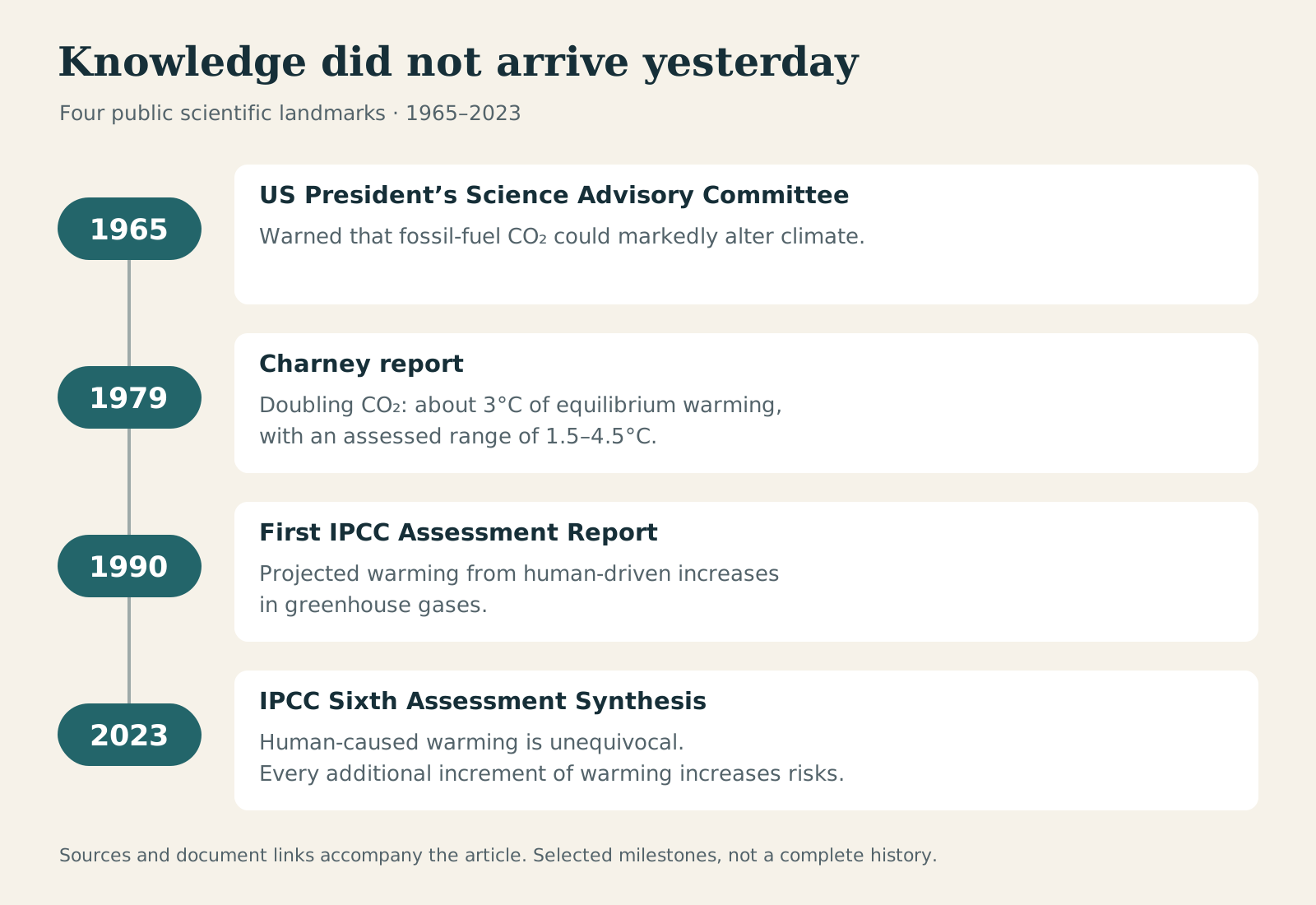
In November 1965, a report from the US President’s Science Advisory Committee described how burning fossil fuels was increasing atmospheric carbon dioxide. It warned that the resulting increase could produce marked climatic changes. The document was published by the White House. This was a warning inside government, more than sixty years before the present argument.[1]
In 1979, the National Research Council’s Charney report estimated that a sustained doubling of atmospheric carbon dioxide would eventually warm the planet by around 3°C, with an estimated range of 1.5–4.5°C. That was an equilibrium estimate, not a forecast for a particular year.[2]
By 1990, the first IPCC assessment stated that human activities were substantially increasing greenhouse-gas concentrations and that this would enhance warming. Its authors still faced major uncertainties, including how confidently observed changes could be attributed to human influence. The warning did not require every remaining question to be settled.[3]
These dates matter because they demolish the comforting story of a crisis that appeared too suddenly for anyone to respond. Knowledge developed over time. So did the opportunity to act. A government reading the 1965 report faced a different decision from one reading the IPCC today, but neither was staring at a blank page.
I do not expect a person in the 1960s to have understood every consequence we now investigate. I do expect successive governments, with successive rounds of evidence, to have treated a growing threat as something more consequential than a recurring communications problem.
There is a point at which demanding greater certainty becomes a way of refusing to make a decision. The responsibility is especially clear when delay itself changes the conditions under which everyone else must live.
Knowledge reached the boardroom too
The record is not confined to government reports. A 2023 study in Science assessed the warming projections documented by Exxon and ExxonMobil scientists between 1977 and 2003. Most tracked subsequent warming accurately; the researchers also identified contradictions between the company’s scientific findings and its public statements.[5]
That finding is much more damaging than a vague accusation that business failed to appreciate an unfamiliar problem. It shows why we should examine particular organisations, particular decisions and particular forms of public persuasion. Responsibility becomes easier to evade when everything is dissolved into a general story about human nature.
The familiar defence is that companies supplied the energy people wanted. There is truth in the demand side of that argument. We used the fuel. Many of us enjoyed the convenience, the mobility and the abundance it helped provide.
But supplying a product does not settle the question of what its seller knew, what it told the public, or how it responded to efforts to change the system. Nor does buying that product give a customer the same power as the organisations shaping investment, infrastructure and political debate.
A commuter trying to keep a job cannot redesign a national transport system before leaving for work. A minister, an investor and an industry lobby each have different choices available. Any serious account of responsibility must preserve those differences. Otherwise collective blame becomes a remarkably efficient shelter for concentrated power.
The comparison we would rather avoid
I think future generations may judge our behaviour as harshly as we now judge the Atlantic slave trade. Perhaps more harshly, given the reach and persistence of the harm we are prepared to leave behind. That is my judgement about moral responsibility, not a calculation that can be settled by counting victims across centuries.
The history deserves more respect than being used as a convenient synonym for wickedness. Atlantic slavery involved the ownership of human beings, violent coercion and the destruction of families. People subjected to it spoke, resisted and argued for their freedom. In his 1789 narrative, Olaudah Equiano addressed Parliament directly about the suffering created by the trade.[6]
The lesson is not that people in the past possessed no moral vocabulary and waited patiently for us to invent one. Some of the people most entitled to condemn the system were already condemning it. Their voices were inconvenient to those who benefited.
What troubles me is the possibility that our descendants will recognise a similar habit of justification: profitable arrangements presented as indispensable, suffering treated as someone else’s problem, and economic disruption offered as a reason to postpone change.
The mechanisms and histories are different. The question about power remains brutally clear. How much harm are comfortable people permitted to impose on others before the comfort stops being a defence?
We readily imagine ourselves taking the courageous side of historical disputes. We are much less enthusiastic when courage might affect the price of our property, our investments or the things we regard as normal. Moral clarity is cheap when all the difficult decisions belong to dead people.
There is no guarantee that future societies will share our values or judge us fairly. I am not invoking an imaginary tribunal that will inevitably endorse my politics. I am asking whether the reasons we offer one another would remain persuasive to the people required to live with the consequences.
“We” hides an enormous amount
Even the phrase the generations that knew needs an argument about who “we” includes. A wealthy frequent flyer and a family struggling to obtain reliable electricity do not occupy the same position. Neither do the owner of a fossil-fuel asset and the worker whose community depends on it.
The IPCC’s 2022 mitigation assessment estimated that the highest-emitting tenth of households, ranked by emissions per person, accounted for 34–45% of global consumption-based household greenhouse-gas emissions. The lowest-emitting half accounted for 13–15%. These are household consumption figures, not shares of all emissions worldwide.[7]
That distribution makes indiscriminate moralising useless. Asking everyone to feel equally guilty conceals the scale of the choices available to the people with the most money and influence. It also invites an obvious and justified objection from those being asked to sacrifice necessities while others defend luxuries.
I would assign responsibility according to knowledge, contribution, power and freedom to act. Those categories overlap, but they are not identical. Someone who inherits an energy system has obligations within it; someone paid to obstruct its replacement carries an additional burden.
This is also why a climate policy that casually destroys livelihoods is politically foolish and morally inadequate. The person whose job disappears is real. So is the person whose home becomes uninhabitable. A serious transition must take both seriously instead of recruiting one as an excuse to abandon the other.
We had already written this distinction into international policy. The 1992 UN climate convention placed protection of present and future generations among its principles, alongside equity, differing responsibilities and differing capabilities. Developed countries were expected to take the lead.[8]
Read that now. The idea that responsibility is unequal was not a revelation awaiting another generation of conferences. It was there in the agreement.
An inheritance they cannot refuse
The most disturbing feature of climate responsibility is the distance between making a decision and living through its full effects. A person can enjoy the returns from an investment, retire, die and leave other people to manage part of its physical legacy.
The IPCC’s 2021 physical-science assessment explains that some changes in the oceans, ice sheets and sea level persist for centuries to millennia. Sea-level rise continues long after global surface temperature is stabilised. The duration of those effects extends far beyond an electoral term, a corporate career or a human life.[9]
Our descendants cannot negotiate retrospectively with a power station. They cannot vote in an election held before they were born. If we describe them only as beneficiaries of whatever wealth we leave, we quietly award ourselves the right to decide which risks they must accept in exchange.
A house is a useful inheritance. A house requiring ever more expensive protection from the sea is a different proposition. Financial assets and a damaged physical environment do not arrive in separate worlds. The value of the former depends on people being able to live and work in the latter.
There is already research that measures the generational difference. A 2021 study by Wim Thiery and colleagues modelled lifetime exposure to climate extremes. Under the climate pledges considered in that study, children born in 2020 faced much greater exposure than people born in 1960; stronger mitigation substantially reduced the inequality.[10]
The moral point does not depend on treating that particular scenario as a prediction of today’s policies. Birth year can determine how much of the damage someone experiences, while giving them no influence over the earlier decisions that helped produce it.
It is hard to invent a cleaner example of power without consent.
The economy is supposed to serve somebody
I find the economic defence of delay particularly revealing. When protecting an investment today becomes a reason to leave an expensive and dangerous problem to other people tomorrow, the word rational has become suspiciously selective.
The people making the decision may indeed be behaving rationally within the rules they face. That is an argument for examining the rules. A system that rewards the transfer of costs to people unable to object should not acquire moral authority merely because its accounting is internally consistent.
The same applies to growth. More useful goods, better homes, reliable energy and longer, healthier lives are worth wanting. A rising total of transactions is an inadequate answer to the question of whether the arrangements producing it can endure.
Suppose a balance sheet improves because a company receives the benefit of an activity while someone else bears its damage. We should be able to call that a failure without first proving that every form of trade, investment or technological development is worthless.
I have little patience with the demand that critics must design an entire replacement civilisation before being allowed to point out a destructive incentive. We routinely repair systems without abolishing every useful thing they contain. An economy should be judged by the lives it makes possible, including lives that begin after its present decision-makers are gone.
This is where I think the defence of perpetual expansion becomes intellectually lazy. If our prosperity requires us to keep enlarging a physical burden that other people must absorb, then the description of prosperity is missing the bill.
The verdict is still being written
None of this gives us permission to retreat into the satisfaction of announcing that it is all too late. Fatalism offers a peculiar comfort: if nothing can make a difference, nobody has to make an awkward decision.
The IPCC’s 2023 synthesis identifies net-zero CO₂ and strong cuts in other greenhouse gases as necessary to limit human-caused warming.[4:1]
That makes action more demanding, not less. We have to reduce avoidable damage while preparing for consequences already developing. The argument cannot end at a distant target or an impressive technology demonstration. It has to reach the decisions about what gets financed, built, protected and replaced.
There is a practical question behind every declaration of concern: who is going to do something differently? A government can change an investment rule. An institution can change what it funds. A community can demand protection. An engineer can help make a cleaner option work. None possesses the whole solution; each can alter a piece of the outcome.
We should also judge action by what it achieves, rather than by whether it makes the person taking it feel virtuous. An expensive gesture that changes little deserves less admiration than an unglamorous measure that prevents harm. This is too serious to become a competition in personal innocence.
Future historians may distinguish the people who denied the evidence, the people who exploited delay, the people who tried and failed, and the people who achieved something useful. We should give them those distinctions to find. The existence of a grave collective failure does not make every individual effort meaningless.
I do not expect our descendants to forgive us because the problem was complicated. They will have complicated problems of their own, including the ones we leave them. Nor do I think a folder full of ambitious promises will impress anyone who has had to abandon a place those promises were supposed to help protect.
The question I keep returning to is simple enough. When we knew that our choices would shape other people’s ability to live decent lives, what did we decide those lives were worth?
We are still answering it. Every claim that we cannot afford to act is part of the answer. So is every decision to act anyway.
Sources
President’s Science Advisory Committee, Environmental Pollution Panel (1965). Restoring the Quality of Our Environment, Appendix Y4, “Atmospheric Carbon Dioxide”, especially pp. 126–127. Primary report excerpt. ↩︎ ↩︎
National Research Council (1979). Carbon Dioxide and Climate: A Scientific Assessment. doi:10.17226/12181. Scanned report. ↩︎ ↩︎
IPCC (1990). Climate Change: The IPCC Scientific Assessment, Policymakers Summary. Original summary. See also the original scientific assessment reproduced in the 1990 and 1992 assessments. ↩︎ ↩︎
IPCC (2023). Climate Change 2023: Synthesis Report, Summary for Policymakers, especially B.1 and B.5. Assessment. ↩︎ ↩︎
Supran, G., Rahmstorf, S. and Oreskes, N. (2023). “Assessing ExxonMobil’s global warming projections.” Science, 379, eabk0063. doi:10.1126/science.abk0063. Abstract and publication record. ↩︎
Equiano, O. (1789). The Interesting Narrative of the Life of Olaudah Equiano, or Gustavus Vassa, the African. Written by Himself. Dedication and Chapters II, V and XII. Primary text. ↩︎
IPCC (2022). Climate Change 2022: Mitigation of Climate Change, Summary for Policymakers, B.3.4. Assessment. ↩︎
United Nations (1992). United Nations Framework Convention on Climate Change, Article 3.1. Convention text. ↩︎
IPCC (2021). Climate Change 2021: The Physical Science Basis, Summary for Policymakers, B.5, especially B.5.4. Assessment. ↩︎
Thiery, W. et al. (2021). “Intergenerational inequities in exposure to climate extremes.” Science, 374, 158–160. doi:10.1126/science.abi7339. Manuscript and supporting material via NASA. ↩︎