In this essay
Suppose an engineer tells you that a bridge may have a serious structural problem. She can explain the mechanism. She can show you the worrying measurements. She cannot yet give you a reliable probability of collapse.
You would ask what needs inspecting, what loads the bridge can safely carry, and whether people should keep using it. You would not congratulate yourself on the absence of a definitive collapse forecast, then send heavier lorries across it.
That is the absurdity I want us to recognise in climate politics. Uncertainty about the full extent of a danger keeps being invited to do the work of evidence that the danger is manageable. The scientific caution survives the journey into public debate. The reason for being cautious somehow gets lost.
The comforting mistranslation
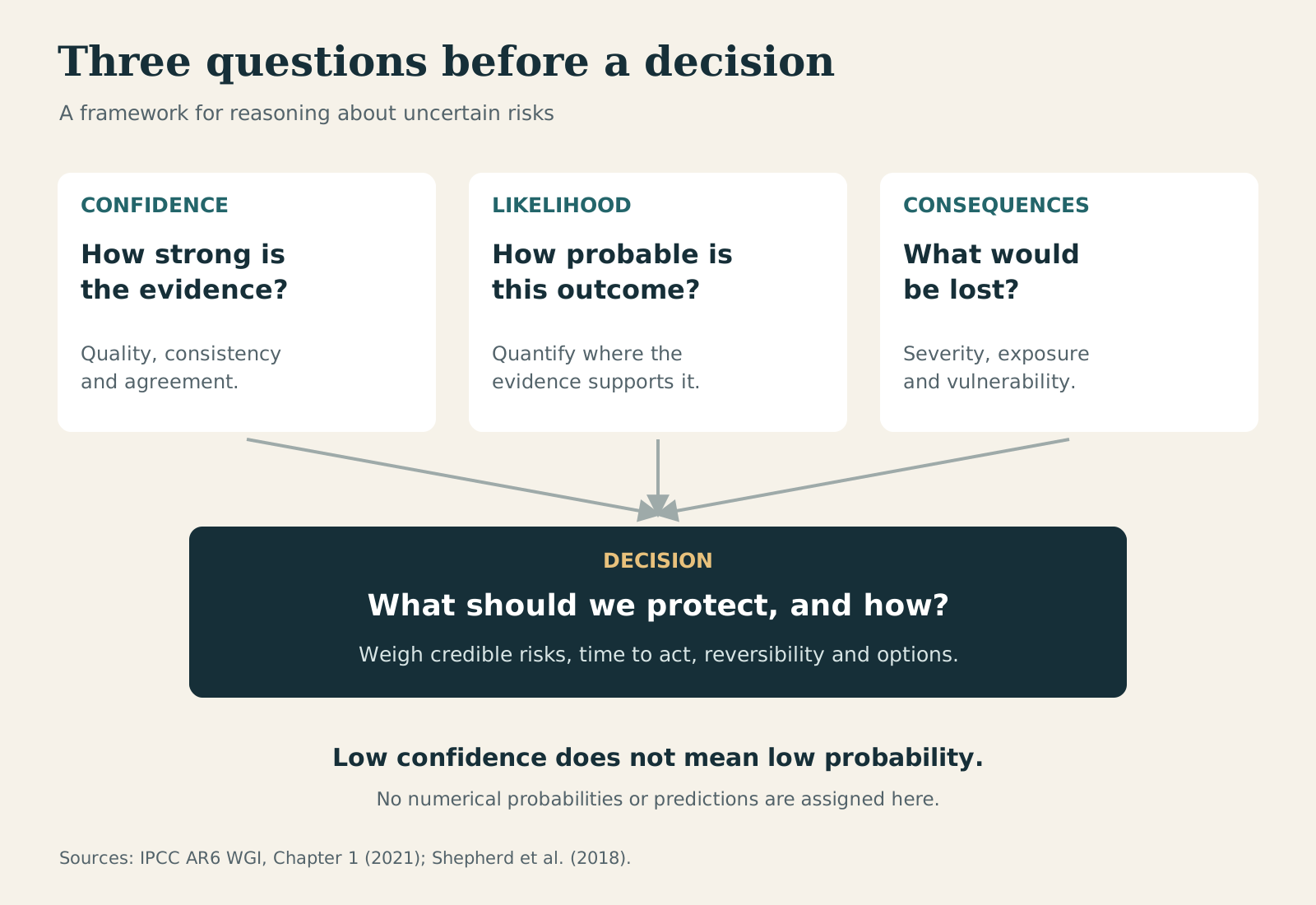
Climate science has a vocabulary for uncertainty. The IPCC uses confidence to describe the strength of evidence and agreement supporting a finding. Likelihood describes an assessed probability. Those are different properties: uncertainty about an estimate is not automatically evidence that the event is improbable.[1]
The distinction sounds fussy until somebody's future depends on it.
We can know that a mechanism is physically credible while knowing much less about when it might become decisive. We can have strong evidence of an underlying hazard and an incomplete understanding of how it will interact with a particular city's water supply, housing or institutions.
Calling the remaining questions uncertain tells us where our knowledge runs thin. It does not tell us how much damage we can afford to accept. That second judgement belongs to society, and society should stop hiding it inside technical language.
My objection is to the comfortable interpretation: if scientists cannot put a firm number on the worst consequences, perhaps those consequences can be left outside the discussion. This is a splendid arrangement for anyone who benefits from delay. It is a poor arrangement for everyone expected to live with the result.
There is a further indignity here. The people exposed to a risk are asked to wait while those authorising it decide whether the evidence has become sufficiently persuasive. The burden of proof falls on the prospective victims; the convenience of uncertainty belongs to someone else.
Give the models their due
Concern about underestimated danger does not justify dismissing climate models. In a 2020 evaluation, Zeke Hausfather and colleagues examined projections published between 1970 and 2007. They found substantial skill in anticipating subsequent global warming, especially after accounting for differences between assumed and actual climate forcings.[2]
That result matters. The broad warning was useful decades before every detail was settled. The evidence does not support the comforting story that scientists only recently discovered what was happening. Nor does it support a simple story in which every projection was too mild.
I have no patience with the idea that science becomes more honest when it becomes more frightening. A gloomy exaggeration is still an exaggeration. Readers deserve an argument that can survive an inconvenient result, including a result showing that the models did a respectable job.
There is, however, a serious argument about scientific culture. In 2013, Keynyn Brysse and colleagues examined cases of underprediction and proposed that norms of restraint can favour less dramatic interpretations. Their paper also acknowledged overprediction. It is a hypothesis about how assessment can go wrong, not a universal correction factor to apply to every forecast.[3]
The useful question is where a particular assessment might omit or underweight a consequential process. We should ask for the mechanism, evidence and consequences. Merely turning up the emotional volume adds nothing to our understanding.
Scientific restraint is valuable because claims need to withstand scrutiny. Trouble starts when restraint in describing the evidence is treated as a recommendation for restraint in responding to it.
A central projection is not a safety certificate
Imagine designing a flood defence around the middle of a projected range and giving no further thought to the upper end. The middle may be the best single estimate available. It still cannot answer how much overtopping is tolerable, what happens if the defence fails, or whether it can be strengthened later.
Those questions become more pressing when failure would be irreversible or adaptation would take decades. A decision made today can close off options long before uncertainty is resolved. Waiting is therefore a choice about exposure, not a pause button outside the problem.
The IPCC makes this point more clearly than its reputation for caution might suggest. Its 2021 physical-science assessment explicitly includes low-likelihood, high-impact possibilities in risk assessment: ice-sheet collapse, abrupt changes in ocean circulation and some compound extremes. It also warns that major impacts can occur within the assessed warming range.[4]
The warnings are in the assessment. They have not been hidden in a forbidden drawer.
When a public discussion offers the central projection as if it defines the limits of concern, it is narrowing the evidence. A reader should be able to see which outcomes are well supported, which remain difficult to quantify, and what would follow if a damaging possibility occurred.
This requires proportion. A physically unsupported nightmare does not earn a place in planning merely because it is terrifying. Evidence must establish plausibility. Consequences and available responses then determine how much attention that possibility deserves. The alternative to complacency is disciplined examination.
Danger does not wait for a tidy probability
Tipping points make this uncomfortable. David Armstrong McKay and colleagues' 2022 synthesis identified warming thresholds beyond which changes in parts of the climate system could become self-sustaining. Several assessed threshold ranges overlap the Paris Agreement's 1.5°C to below-2°C range above pre-industrial temperatures. These are uncertain ranges, not a timetable of disasters.[5]
Crossing a threshold and completing the resulting change are also different events. The point of studying a threshold is to identify when a process may become difficult to halt, rather than waiting until its consequences are complete. We should be especially interested in warning signs that arrive while choices remain.
Consider what certainty might cost in that setting. If the definitive evidence arrives only after a system has crossed a threshold, insisting on that evidence before responding has built failure into the decision rule. Better monitoring helps, but monitoring is not a substitute for limiting the pressure causing the risk.
Even without a tipping point, unprecedented weather can defeat expectations shaped by experience. A 2021 modelling study by Erich Fischer and colleagues found that warming can produce heat extremes that exceed previous records by unusually large margins. Their likelihood depended partly on the rate of warming.[6]
An event can therefore be startling without proving that climate models are useless. Equally, having survived the worst event in living memory is a feeble basis for confidence about the next few decades. Experience is a valuable teacher; it cannot guarantee that the syllabus will stay the same.
The questions we have barely asked
There is another gap between projecting climate and understanding what it could do to civilisation. A temperature projection does not itself describe how food markets, public finances, health systems and political institutions would behave under prolonged, interacting stresses.
Luke Kemp and colleagues argued in their 2022 Climate Endgame paper that catastrophic climate scenarios deserve much more research. They proposed examining extreme outcomes, cascading failures and the interaction of climate hazards with social vulnerability. The paper sets out a research agenda; it does not calculate a settled probability of global collapse.[8]
That is enough to justify taking the questions seriously.
I would want to know what happens when a government must respond to repeated harvest losses while also repairing flood damage and paying more for imported food. I would want researchers to investigate where emergency capacity runs out, how failures spread, and what prevents them spreading. These are questions to test, not a script for an inevitable future.
We should welcome work that discovers a strong buffer, a misleading assumption or a danger smaller than feared. We should welcome work that exposes a vulnerability just as readily. The purpose is to find out what matters while something can still be done about it.
There is no intellectual merit in keeping the most consequential questions off the table until somebody has already answered them.
The politics of demanding more proof
Climate obstruction does not require denying that the planet is warming. William Lamb and colleagues described a range of arguments that acknowledge climate change while justifying inadequate action: shifting responsibility, promoting insufficient responses, emphasising policy costs or surrendering to the problem.[9]
Their framework is useful because a superficially reasonable statement can perform unreasonable work. Yes, a transition has costs. Yes, particular policies can be badly designed. Yes, technology may improve. None of those observations answers whether postponing effective action produces an acceptable result.
I want the same scrutiny applied to continuing as before. If a company asks society to accommodate a long-lived polluting investment, the uncertainty surrounding its consequences belongs in that decision. It cannot fairly become everybody else's problem while the return on the investment remains the central consideration.
The same goes for government. A minister is entitled to challenge the cost and effectiveness of a proposed measure. The minister should also explain the exposure created by delay, who bears it, and which future options the decision removes. Demanding numbers from only one side of the choice is accounting by preference.
This is where I become impatient with the language of responsibility. A policy can sound measured while accepting enormous risks for people absent from the room. Calm delivery does not make the choice cautious. A serious argument should examine the consequences before awarding itself that description.
Scientists cannot decide, on our behalf, what losses are morally acceptable. Asking them for a more precise projection does not relieve politicians, businesses or the public of making that judgement.
Put uncertainty to work
There are constructive ways to investigate futures we cannot confidently rank. Theodore Shepherd and colleagues describe a storyline approach: examine a physically consistent sequence of events, establish its plausibility and explore the vulnerabilities it exposes, without pretending to know its exact probability.[7:1]
Take an explicitly hypothetical example. A city faces a hot, dry summer while one important electricity supply is unavailable. The useful investigation would identify which services fail first, which households are exposed, what backup arrangements exist, and whether the proposed remedy creates another dependency.
That exercise has value even if nobody can assign a trustworthy percentage to the whole sequence. Its assumptions must be visible and challenged. Its purpose is to discover a practical weakness, not to smuggle an imaginary catastrophe into the record as a forecast.
I would rather see public authorities explain such tests than announce that they are prepared for an average future. Preparation should include identifying what can be protected, what cannot, what needs redundancy and which decisions become expensive to reverse. It should also explain where resources would achieve little and could be used better.
This approach does not demand an unlimited budget for every possible disaster. It demands comparisons. How severe is the failure? How credible is the pathway? How long would a remedy take? Does an intervention help under several plausible futures? What would make us change course?
Those are demanding questions. They are also much closer to responsible government than waiting for science to eliminate uncertainty and calling the wait prudence.
Fear is no excuse for surrender
There is a temptation, after looking at enough unpleasant possibilities, to conclude that emissions reductions are merely rearranging the deckchairs. I understand the anger behind that conclusion. It should not determine our reading of the evidence.
The IPCC’s 2023 synthesis finds that emissions cuts limit future harm, even when some changes persist for centuries.[10]
An avoidable loss remains worth avoiding even if other losses are already unavoidable. The fact that we cannot save everything does not give us permission to sacrifice whatever remains. Fatalism can become an extraordinarily convenient philosophy for institutions that would prefer to change nothing.
I distrust assurances that everything will work out. I also distrust the satisfaction of declaring everything hopeless. Both can spare us the harder task of choosing what to protect, paying for it and challenging the interests that make delay attractive.
The evidence is strong enough to demand action and incomplete enough to demand serious attention to worse outcomes. Holding those thoughts together requires no dishonesty. It requires us to stop treating an unfinished scientific question as an acquittal.
People inheriting the consequences should not have to prove precisely how we will hurt them before we agree to stop making their future more dangerous.
Sources
IPCC (2021). Climate Change 2021: The Physical Science Basis, Chapter 1, Box 1.1 and Section 1.4.4. Uncertainty, confidence, likelihood and low-likelihood outcomes. ↩︎ ↩︎
Hausfather, Z., Drake, H. F., Abbott, T. and Schmidt, G. A. (2020). “Evaluating the Performance of Past Climate Model Projections.” Geophysical Research Letters, 47, e2019GL085378. DOI: 10.1029/2019GL085378; NASA author publication record and abstract. ↩︎
Brysse, K., Oreskes, N., O'Reilly, J. and Oppenheimer, M. (2013). “Climate change prediction: Erring on the side of least drama?” Global Environmental Change, 23(1), 327–337. DOI: 10.1016/j.gloenvcha.2012.10.008; author institution record and abstract. ↩︎
IPCC (2021). Climate Change 2021: The Physical Science Basis, Summary for Policymakers, C.3. Low-likelihood, high-impact outcomes. ↩︎
Armstrong McKay, D. I. et al. (2022). “Exceeding 1.5°C global warming could trigger multiple climate tipping points.” Science, 377, eabn7950. DOI: 10.1126/science.abn7950; indexed abstract. ↩︎
Fischer, E. M., Sippel, S. and Knutti, R. (2021). “Increasing probability of record-shattering climate extremes.” Nature Climate Change, 11, 689–695. DOI: 10.1038/s41558-021-01092-9. ↩︎
Shepherd, T. G. et al. (2018). “Storylines: an alternative approach to representing uncertainty in physical aspects of climate change.” Climatic Change, 151, 555–571. DOI: 10.1007/s10584-018-2317-9. ↩︎ ↩︎
Kemp, L. et al. (2022). “Climate Endgame: Exploring catastrophic climate change scenarios.” Proceedings of the National Academy of Sciences, 119(34), e2108146119. DOI: 10.1073/pnas.2108146119; open-access article. ↩︎
Lamb, W. F. et al. (2020). “Discourses of climate delay.” Global Sustainability, 3, e17. DOI: 10.1017/sus.2020.13. ↩︎
IPCC (2023). Climate Change 2023: Synthesis Report, Summary for Policymakers, B.1–B.3. Warming, escalating risks and the effects of emissions reductions. ↩︎