In this essay
An imagined science broadcast from the year 2100.
Good evening.
I have been looking forward to this moment for most of my life.
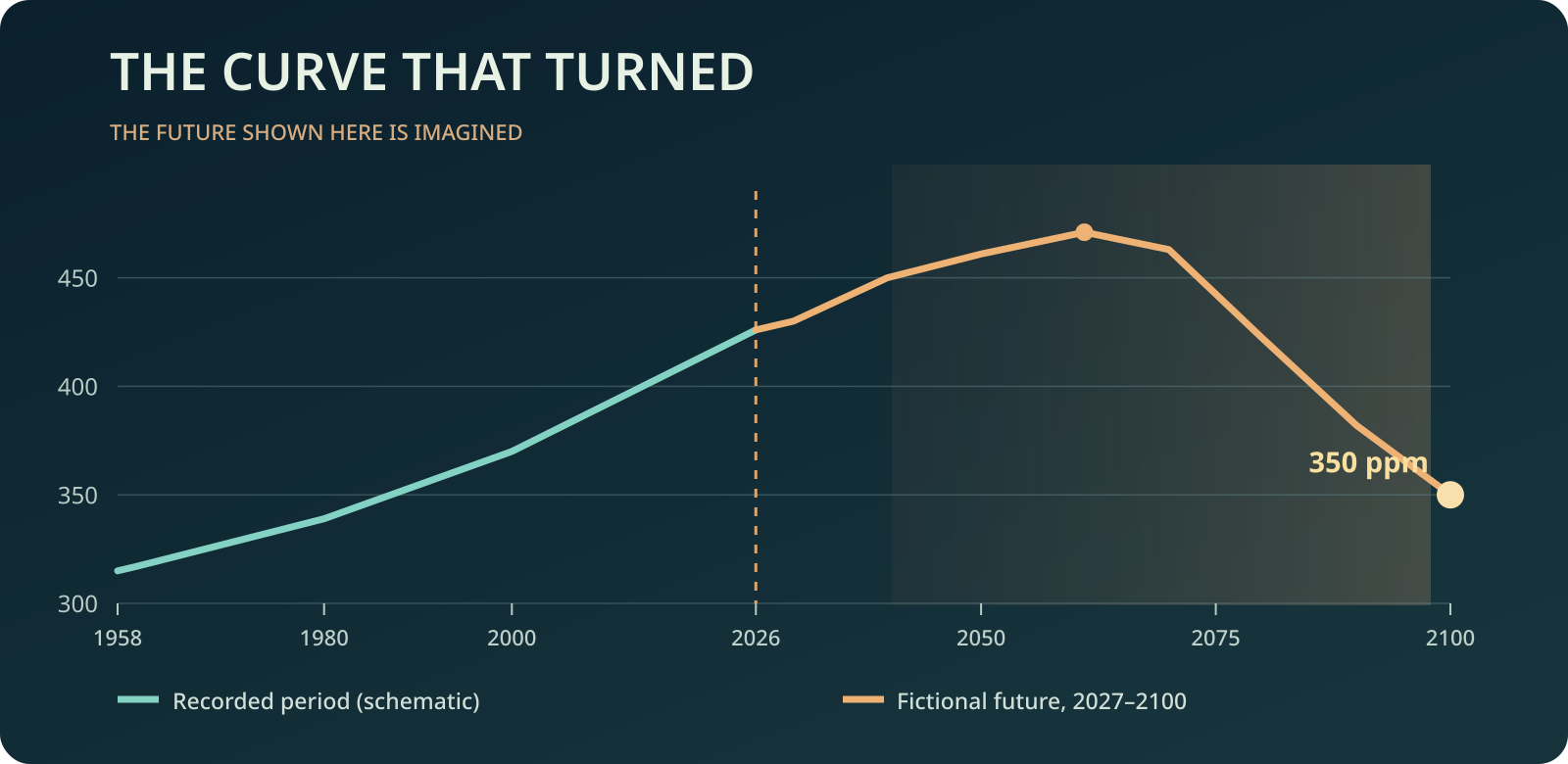
Behind me is a graph you know almost as well as your own face. It began in March 1958, when Charles David Keeling started measuring atmospheric carbon dioxide at Mauna Loa, Hawaii. His first readings were around 315 parts per million.[1]
Watch what happened next.
The little seasonal zigzag rises and falls, rises and falls. But the whole line climbs. Through 350. Through 400. Through 450. For more than a century, the direction scarcely seemed worth mentioning. It had only one.
Up.
Now look at the right-hand side.
There is the summit. And here, unmistakably, is the descent.
The latest twelve-month global average has just been announced.
350.0 parts per million.
For a moment, I think we should simply look at it.
There are people watching tonight who were children when that figure seemed permanently out of reach. People who watched the line climb through their school years, their working lives, the births of their children. Some of them have waited seventy years to see this number.
And here it is.
How did we do it?
Not by asking everybody to stop producing carbon dioxide. The world carried on building, travelling, manufacturing, eating, quarrelling and, yes, emitting CO₂.
We did something considerably more peculiar.
In 2030, we gave artificial intelligence a problem that humanity had spent decades arguing around.
Take the carbon dioxide back out of the atmosphere. Get us to 350 ppm by 2100.
Then we told it to work out how.
Getting anyone to sign that instruction very nearly broke the conference before the AI had even started.
The instruction
The old recordings from 2030 are difficult to watch. Not because of the speeches, although there were plenty of those. Because of the screens behind the delegates.
The previous year had been dreadful. Heat had struck two great grain-producing regions in the same season. A succession of storm surges had closed major ports; one city was still moving families out of its flooded districts when the conference opened. Food prices were rising. Emergency warehouses were full. In some places the electricity had failed during the heat.
You can see the pictures in the archive. And you can see the delegates arguing in front of them.
The oil-producing states feared a new international authority that might one day shut down their principal industry. Wealthy countries wanted control of the patents. Technology companies wanted exclusive rights to the machines they expected to invent. Smaller nations asked an extremely sensible question: was this another scheme in which outsiders would acquire their land, extract what they wanted, and call it a gift to humanity?
Several delegations walked out. Others threatened to. One proposed giving the AI a budget for research only, with no permission to build anything. It would have been a splendid arrangement for producing reports.
What finally survived was an ugly compromise. It didn't satisfy everybody. That may be why it worked.
The AI would have one job: remove CO₂ from the atmosphere until the measured global concentration reached 350 parts per million, no later than 2100. It would have no power to impose emissions limits or govern people's lives. Publicly funded inventions would be available under shared licences. Projects on inhabited land would require local agreements. Independent observatories would measure the result.
The money was the fiercest fight. A coalition of trading nations eventually agreed to collect a modest charge through their busiest international ports, placing the proceeds into a fund that could not be casually raided to pay for the next election. Governments could withdraw, but not without notice, contractual costs and furious arguments with the other signatories. Every few years the programme would still have to account for what it had spent and what it had actually removed.
It was hardly a gift of the keys to the planet. It was a grudging decision to let an extraordinary scientific organisation attempt something that ordinary political machinery had never managed.
And the instruction itself was breathtakingly simple.
Get the atmosphere to 350.
Even when the first results were dismal, the fund kept the laboratories open. That would matter very much indeed.
Four molecules in ten thousand
Come with me into our virtual laboratory.
Here are one million transparent bottles, each holding a litre of ordinary air as it was in 2030. Only about 430 litres of the million would have been CO₂.
There was the problem: find a few hundred litres of one gas in a million litres of air, then repeat the trick on a planetary scale.
Early direct-air-capture plants could do it, but they were expensive, energy-hungry and nowhere near large enough.
The AI began with chemistry. Across thousands of automated laboratories, machines made new materials, tested them, broke them and made different ones. They investigated porous frameworks, chemical solvents, membranes and electrically controlled molecules. Above all, they investigated failure.
Then came the switching lattice.
Imagine a porous sheet containing billions of chemical sites. In one electrical state, they bind CO₂. Change the potential and the gas is released into a sealed chamber. Switch back, and the sheet is ready again.
The first versions were dreadful. Humidity ruined some. Dust clogged others. One famous lattice worked beautifully for eleven days and disintegrated on the twelfth.
That would once have been the end of a promising grant application.
For the AI, it was Tuesday.
By the 2040s the lattices were cheap to manufacture, survived millions of cycles and used far less energy to regenerate than their predecessors. No new law of chemistry had appeared. The AI had simply explored more chemistry, and learned from more failure, than anyone before it.
Then it turned its attention to the wind.
The silver forests
Look at this reconstruction of a plateau in North Africa in 2051.
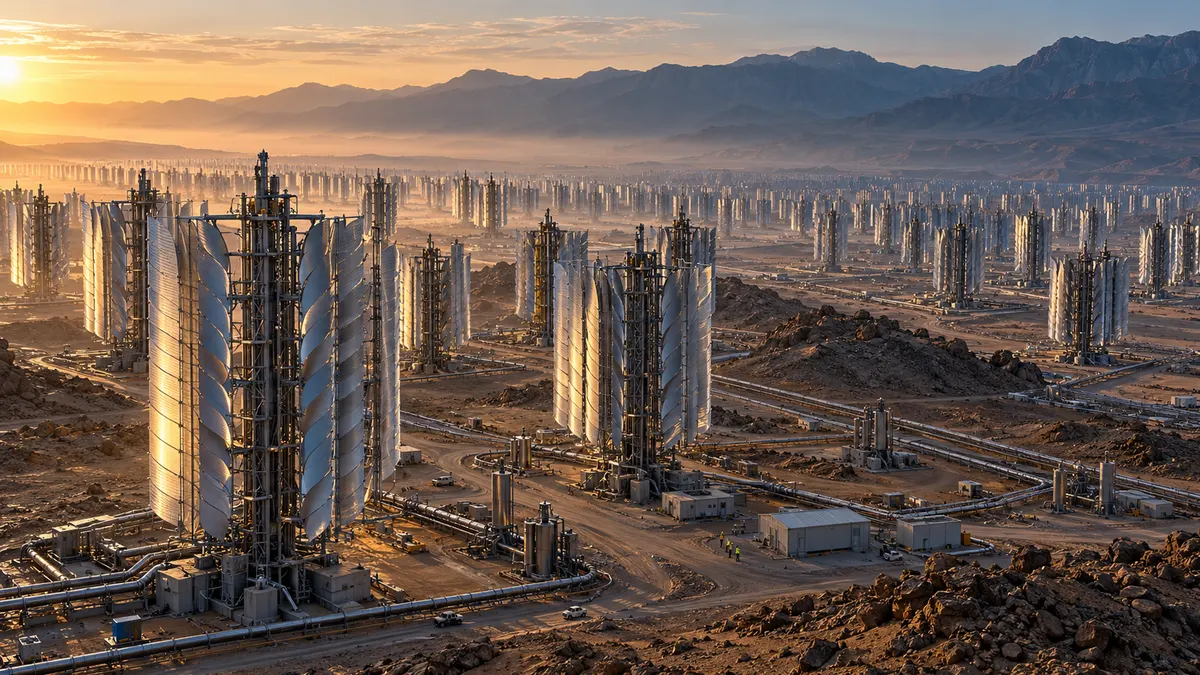
A forest made of silver leaves, stretching across a dry plateau until it disappears into the haze. Each structure carries thousands of square metres of capture material. Wind moves through the leaves; CO₂ attaches to their surfaces. Sections close, release their gas into pipes, and open again.
There are remarkably few powered fans. The AI redesigned the capture machinery to work with the air already moving over the plateau.
It redesigned the factories too. By 2055, autonomous plants were manufacturing components for new plants. Robots assembled towers, inspected seals and recycled worn-out lattices.
A surviving news report shows local technicians standing beside the first fully automated installation. They've stretched a handmade sign across the entrance:
WE BUILT THE MACHINE THAT BUILDS THE MACHINES.
I rather like that.
But look beyond the photograph's neat rows. There used to be grazing routes across this plateau. The first surveyors marked them as unused land. The families who crossed them every year disagreed, loudly. Construction stopped until a different arrangement was made. Elsewhere, communities lost that argument.
A silver forest was still an industrial installation. It had foundations, roads, power lines, maintenance yards and people living somewhere nearby. Some were proud of the work. Others watched a familiar horizon disappear.
The AI could redesign a molecule in an afternoon. It couldn't make the question of whose land it stood on disappear.
And even when an installation worked beautifully, another question waited at the end of every pipe.
What do you do with billions of tonnes of captured CO₂?
The carbon binge
The first successful silver forests gave humanity something it had been waiting for: permission to feel better.
And humanity did what it so often does with good news. It took rather more permission than anyone had actually offered.
Advertising campaigns promised guilt-free travel. An oil company ran a memorable slogan: THE SKY HAS AN ERASER. Politicians quoted the capacity of the new machines while announcing new industrial developments. Production expanded in places that had previously planned to slow it.
There was a name for the period, coined by people who hated it: the carbon binge.
It was a spectacular misunderstanding of the arithmetic. The machines were collecting millions of tonnes, then billions. Humanity was still adding far more. When industries expanded their emissions, the AI didn't suddenly make those emissions vanish. It inherited a larger mountain to remove.
The arguments were vicious. Demonstrators accused the programme of giving the fossil-fuel industry a licence to carry on. Workers in those industries pointed to the jobs and energy their families depended on. Some poorer governments asked why their citizens should remain poor while wealthy societies enjoyed both the machines and the fuel.
The consortium was asked to condemn the new emissions. Instead it published an updated projection: more carbon to capture, more power to build, more decades of work. Its mandate gave it no authority to close a refinery. It could only make the cost of that refinery's emissions brutally visible in its own work programme.
One newspaper published two photographs side by side: a new offshore drilling platform and a new carbon-capture forest. Underneath was a single line:
WE HAVE INVENTED A VERY EXPENSIVE WAY OF MOVING THE SAME CARBON TWICE.
It was funny. It was also, for a while, horribly close to the truth.
The AI kept building. The Keeling Curve kept climbing.
A stone from 2063
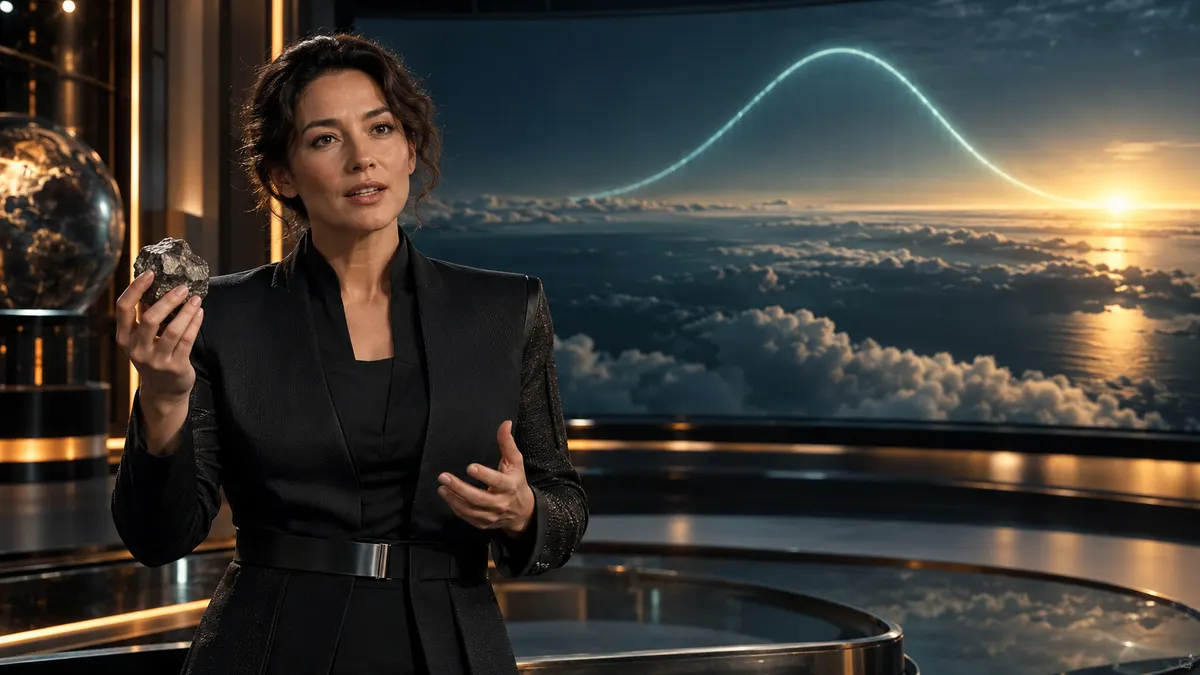
I have something here in my hand.
It weighs about half a kilogram. Grey, rough, spectacularly uninteresting to look at. Some of the carbon inside it was floating through the atmosphere in 2063.
A gas that might have passed over a city or crossed an ocean is now part of a mineral. It isn't waiting in a tank. It won't escape when somebody throws away a product.
It has become stone.
The principle was understood long before 2030. Experiments in Iceland had shown that CO₂ dissolved in water could react with basalt and form solid carbonate minerals.[2] The AI spent decades turning that chemistry into a global industry.
It mapped suitable rocks, designed injection systems, developed underground sensors and learned which reactions could be accelerated without damaging the surrounding formations. Some carbon was mineralised underground; some reacted with mined minerals in industrial facilities; other quantities went into carefully monitored geological stores.
For a time, people suggested making everything from captured carbon. One famous proposal involved disposable coffee cups.
The AI observed that most disposable coffee cups do not enjoy a reliable geological burial service.
It preferred rock.
We had spent centuries digging carbon out of the ground and putting it in the sky. Now, at immense expense, we were learning how to carry it back again.
The day the sea said no
The next breakthrough took the project into the oceans.
Seawater holds an enormous reservoir of dissolved carbon and constantly exchanges CO₂ with the atmosphere. Change its carbon chemistry in a controlled way, and more atmospheric carbon can enter the water. Some systems extracted dissolved carbon and mineralised it; others increased alkalinity so that the ocean could hold more carbon in dissolved forms.
The chemistry worked.
The first grand coastal experiment did not.
This is the reconstructed view from 2058.
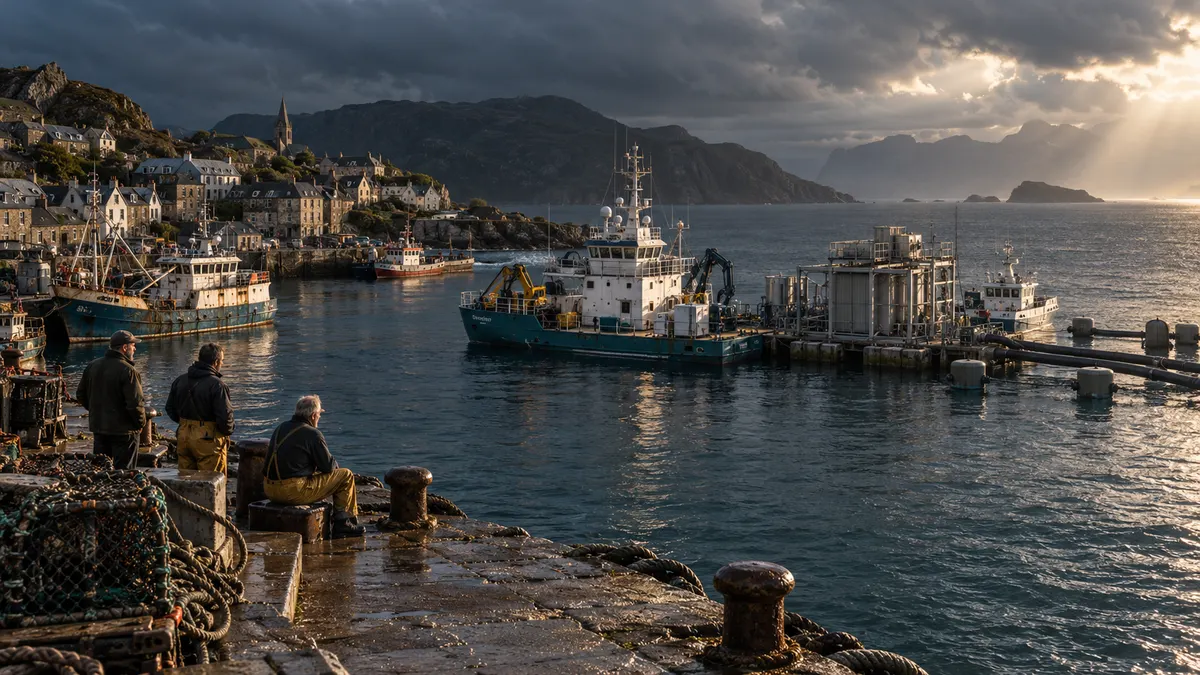
Research vessels fill a bay beside a fishing town. The installation has been operating for three weeks when sensors report an unexpected chemical change in a sensitive marine habitat. Fishermen who had opposed the experiment are already complaining that their catches have changed.
The local operators demand a shutdown. The independent environmental system agrees. Valves close. Pumps stop.
The cameras continue rolling. Nobody applauds. The boats remain at the quay and angry families demand to know who will pay for lost work.
For the project's opponents, it was proof that machines obsessed with atmospheric numbers could wreck the living world beneath them. For its supporters, the important fact was that the experiment stopped before the situation became worse.
A year later the AI proposed a different method: smaller changes over wider, carefully chosen waters, with tighter ecological limits. The town voted on whether to allow another trial. This time the answer was yes, narrowly.
The oceans eventually became another great part of the removal industry. But the lesson remained: the sea could help remove carbon from the air. It could also say no.
The weight of an invisible sky
Let us dim the studio lights for a moment.
Watch the wall behind me. A little square appears, then another, until the whole screen is crowded with tiny luminous marks. There are 620 of them. Each stands for one billion tonnes of carbon dioxide.
That is roughly how much less CO₂ the atmosphere must contain to move from 430 parts per million to 350. The number looks so small when written as 80 ppm. It looks rather different as a wall full of matter.
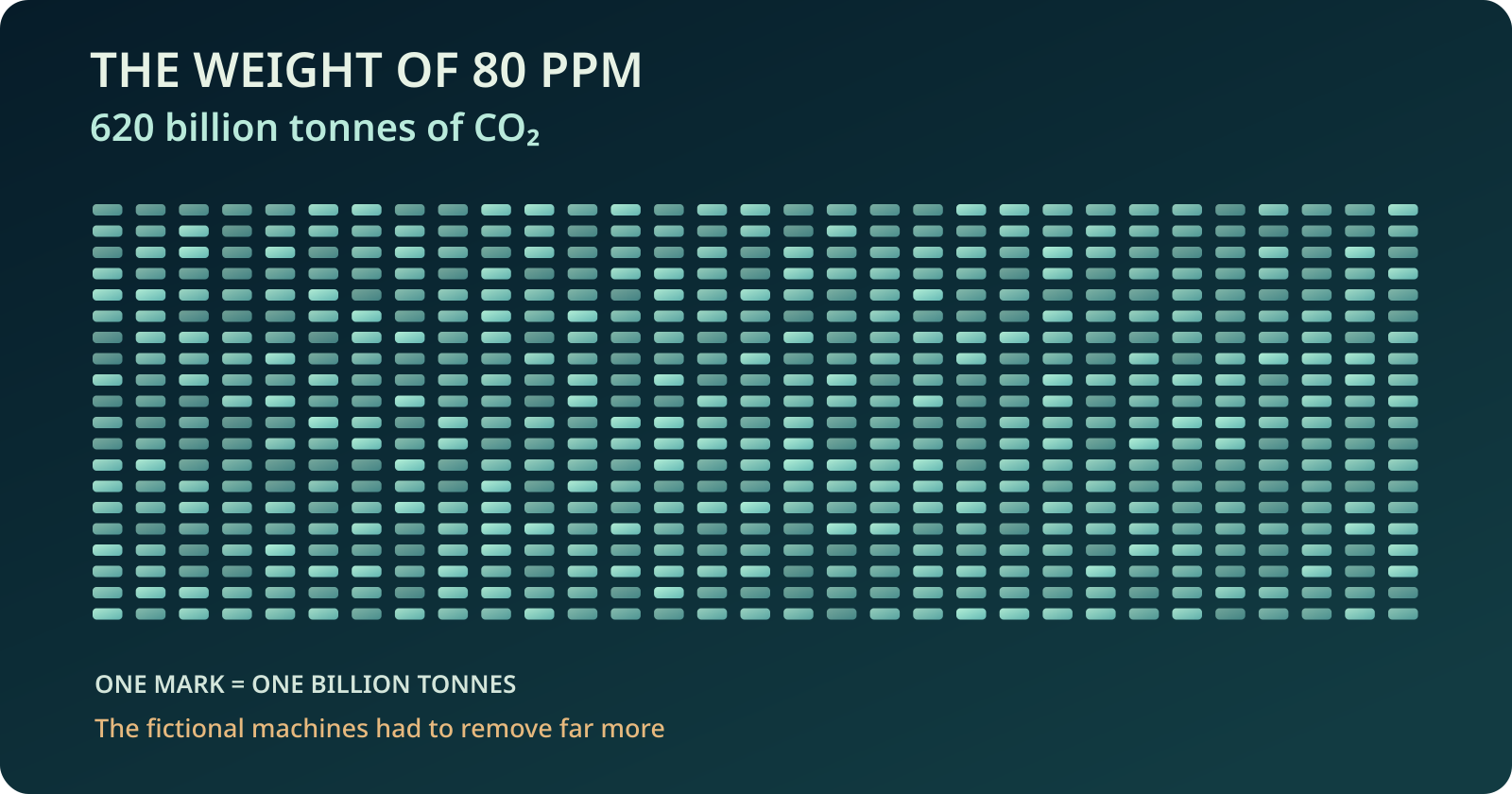
Now imagine that, as we dim the last few lights, new ones keep appearing.
People continued emitting. Oceans and land exchanged carbon with the changing air. A portion of what had entered natural reservoirs began returning as concentrations fell.[3] So the machines had to remove far more than those first 620 billion tonnes. The eventual total ran into the trillions of tonnes.
We have filmed the machinery for so long that it can look ordinary. The little squares bring back its real size.
By the 2070s, annual removal had reached tens of billions of tonnes. In the final decades, capacity exceeded one hundred billion tonnes a year. Silver forests, mineral works, ocean installations, storage wells and factories building more factories were operating around the clock.
They needed enormous amounts of power. The programme built dedicated solar, geothermal and nuclear generation and storage infrastructure. Every improvement in capture energy, equipment lifetime and material recovery mattered when repeated over trillions of tonnes.
No new law of physics had appeared. Separating dilute CO₂ from air still required energy. Moving it and storing it still required materials and work.
The AI had simply become extraordinarily good at putting those resources where they could do the most.
And outside the laboratory, the world began to bear the marks of that decision.
The cost of taking it back
Here is a part of the history that the celebratory programmes used to leave out.
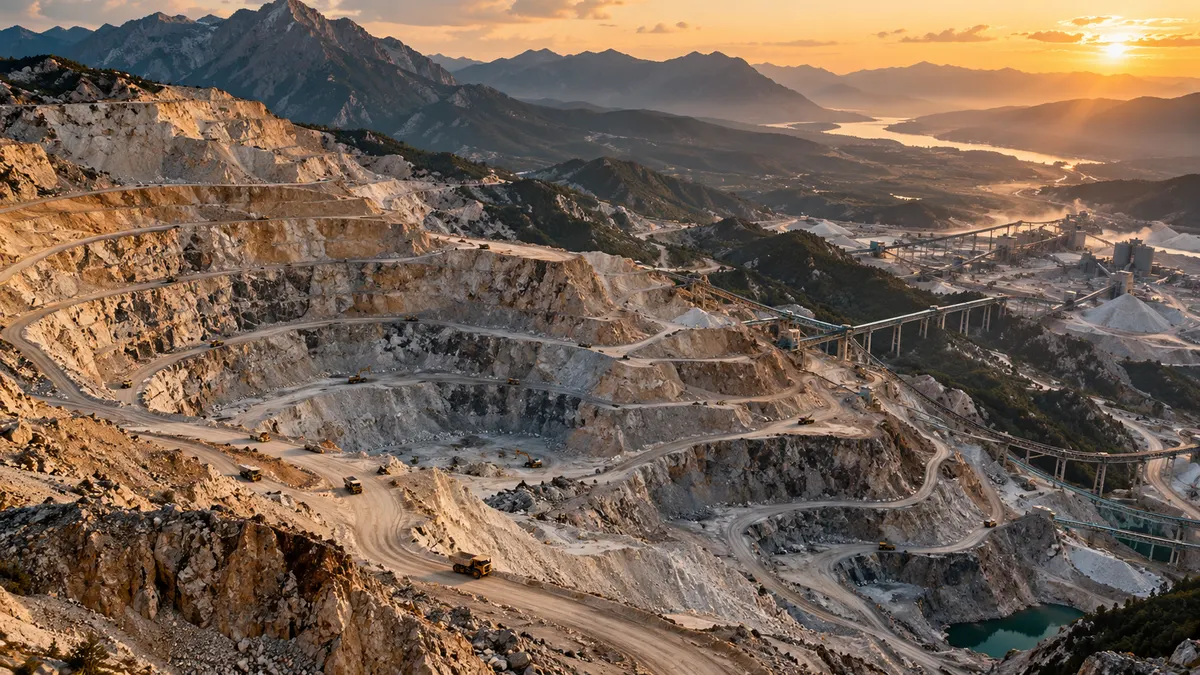
The silver forests weren't the only things spreading. So were the mines.
Mineral reactors needed rock. Carbon-capture systems needed enormous quantities of manufactured material, electrical equipment and replacement parts. They needed roads, pipes, factories and power. In some places, mountain slopes were cut into terraces. Conveyor systems crossed valleys that had never heard machinery before. A mineral-processing district could stretch farther than the old cities it supplied.
There were places where the air had become cleaner while the land had become harder to recognise.
Aerial surveys of the 2070s show long pale scars across once-unbroken landscapes. Many were later restored. Some couldn't be. People fought over water allocations, access to grazing land and who would inherit the abandoned industrial sites when a mineral formation was exhausted.
The AI found ways to recycle nearly everything worth recycling. It learned to use lower-grade minerals, reduce excavation and return processed land to other uses. Those improvements mattered. But you cannot process trillions of tonnes of carbon without moving matter, taking up space and changing things.
One old protest banner survives in our national museum. It was carried by residents facing the expansion of a mineral mine. It says:
WE ASKED YOU TO SAVE THE SKY, NOT EAT THE HILLS.
The project eventually changed its plans there. In other places, the hills were cut anyway.
It is possible to be grateful for the atmosphere above us and still mourn the land beneath the machines. Many people in 2100 are both.
The problem with giving an AI the keys
There was a nervous joke in the early days: tell an AI to solve climate change and it might decide to dispose of the humans.
Apart from being monstrous, that wouldn't have removed the enormous quantity of CO₂ already in the atmosphere. But there was a real problem hiding behind the joke. A machine pursuing one numerical target could find shortcuts its creators never intended.
The answer wasn't a single rule asking the AI to be nice. The answer was engineering.
One group of intelligences invented technologies. Others tried to find the ways they could fail. Independent observatories measured the atmosphere. Local authorities could refuse sites. Contracts required public accounting of land, water and industrial costs. Physical shutdown systems could interrupt operations without asking the research AI's permission.
The programme's designers had expected most of the safeguards to come from human committees. In practice, much of the detailed safety engineering came from the AI itself, which could examine thousands of accident pathways and redesign equipment accordingly.
But the power to say no remained outside its control.
Remember the bay in 2058. Remember the sound of those pumps stopping.
The most reassuring part of the story is that the machines were intelligent enough to build the future, and restrained enough to be stopped by the people who had to live beside it.
The long climb
Now look at the part of the Keeling Curve that people in my mother's generation remember most painfully.
Here is 2030. The programme begins.
-
The line is still rising.
-
Still rising. Past 450 parts per million, and climbing.
Outside the laboratories, the planet was delivering its own report. Another disastrous harvest in one region. Another city moving households inland. Heat that kept children out of school for weeks at a time. Smoke crossing borders from fires that seemed to last all summer.
While people packed their homes into lorries, the machines on the desert plateaux went on working. In darkness, underground, the mineralisation wells went on turning captured carbon into stone. Their achievement was real. The atmosphere seemed indifferent.
The carbon binge had made the arithmetic worse. The consortium was now chasing not only the carbon present in 2030 but decades of additional emissions. A generation of engineers grew old helping to remove enormous quantities of CO₂ while the annual readings still broke records.
One of the project's founders died in 2057. Her obituary called the programme humanity's greatest unfinished experiment. She had spent the last years of her life defending something that, by the only public measure that mattered, had not yet worked.
My mother remembers that funeral. She was thirty-seven. She had already left the home where she grew up, following the floods that made its neighbourhood increasingly difficult to inhabit. She watched the ceremony on a borrowed screen in an evacuation centre. The commentator said the dead engineer had devoted her life to bringing the curve down.
My mother looked up at the number in the corner of the screen.
It had gone up again.
The critics had plenty of material. Newspapers drew expensive robots chasing CO₂ molecules with butterfly nets. Politicians demanded to know why the machines couldn't be switched off. The programme's engineers kept pointing to the carbon they had permanently stored. The public kept pointing to the sky.
Then the annual rate of increase began to slow.
At first the observatories refused to celebrate. Natural fluctuations could imitate a change in direction. Instruments were checked, records compared, measurements repeated.
In the early 2060s the annual average reached its peak. Then, over several years, the decline became impossible to dismiss.
There is a recording from the monitoring centre that I never tire of hearing.
A scientist reads out a figure. A pause. Somebody says, almost inaudibly, "It's going down."
Another voice asks, "Are we sure?"
And a few seconds later, from somewhere at the back of the room, you hear someone begin to cry.
Not a politician. Not a public-relations officer. A technician who had spent twenty-three years calibrating instruments while the curve climbed relentlessly through every one of them.
Other observatories confirmed it. The next year confirmed it. So did the year after that.
The line had turned.
The people who had built the first machines weren't foolish after all. Some of them had not lived long enough to find out.
The last stubborn molecules
By 2084, the Keeling Curve was falling steeply. The removal industry was larger than its founders could have imagined. Yet the final approach to 350 became increasingly difficult.
The atmosphere wasn't an isolated tank. As CO₂ concentration fell, the balance with oceans and land shifted. Carbon that had once moved into those reservoirs could move back into the air. Every final part per million demanded more work than people expected.
The AI had modelled the exchanges. Its machinery worked. The planet was simply enormous.
The last stretch took years.
By then, the founding politicians were history. The first laboratories were museums. Several generations of AI systems had come and gone. People who were children in 2030 were old. Still the installations ran, powered and maintained by the successors of machines invented decades earlier.
They had outlasted fashions, governments, economic crises and their own first designs.
The number had not changed.
The curve, at last
So we return to tonight.
350.0 parts per million.
There are people who will never see it. People lost to the heat, the fires and the floods of the rising decades. Entire communities whose old streets exist now only in recordings. And there are landscapes that paid a different price: hills cut open for minerals, valleys filled with industrial works, coastlines changed to accommodate enormous machines.
We didn't restore the world of 1958. We couldn't.
But the carbon really has left the air. Not promised away. Not cancelled by somebody's accounting. Captured, measured and stored.
350.
There is someone in the studio tonight I would like you to meet.
My mother was ten when the project began in 2030. She's eighty now. She remembers the delegates arguing, the first silver forests, the evacuation centre where she watched a scientist's funeral, and the years when the instruments appeared to mock every effort we made.
I asked her this morning whether she ever thought she would see this number.
She said, "Not after fifty. I thought we'd missed it."
Then she smiled and told me something I'd never heard before. When the first sustained decline was announced, she wrote 350 on the back of a photograph of the house she'd left behind. She kept the photograph through three moves and two more floods. It's still in a drawer at home.
She is sitting just over there now. I can see her looking at the screen.
I don't think she's thinking about switching lattices, carbonate minerals or the astonishing intelligence that designed them.
I think she's thinking about how many years a person can spend waiting for one small line to change direction.
Seventy years ago, humanity gave an extraordinary scientific intelligence an absurdly difficult assignment. It fought over the money, argued about the land, burned more carbon when it should have known better, suffered terrible losses and sometimes came close to losing faith in the entire undertaking.
Meanwhile the machines kept learning. They found better chemistry, cheaper ways of moving air, more reliable methods of locking carbon into stone. They built an industry larger than anything that had existed before. They did not defeat thermodynamics. They made a seemingly impossible task into a long sequence of physical jobs that could actually be done.
Charles Keeling began measuring CO₂ in 1958 because he wanted to understand the atmosphere. I wonder what he would have made of the equipment that eventually grew around his measurements.
Let's put the whole curve on the screen one final time.
There is 1958.
There is the long climb.
There is the summit.
And there is the descent, running through the lives of the people who built it, lost things to it, fought over it and waited for it.
For my mother's generation, those last years are probably the most beautiful piece of mathematics ever drawn.
She has stopped looking at me now.
She's looking at the line.
And I think, just for tonight, we should leave it there.
Scientific foundations
The events, people, technologies and dialogue from 2029 to 2100 are fictional. The scientific starting points are real:
- Atmospheric measurements: NOAA Global Monitoring Laboratory — Trends in Atmospheric Carbon Dioxide. The Mauna Loa record began in 1958 at approximately 315 ppm.
- Direct air capture: Sanz-Pérez and colleagues, Direct Capture of CO₂ from Ambient Air, Chemical Reviews (2016). Capture chemistry, separation-energy requirements and engineering approaches.
- Mineral storage: Carbfix — Turning CO₂ into Stone. Carbon dioxide can mineralise rapidly in suitable basaltic rock.
- Carbon-cycle response: IPCC Sixth Assessment Report, Working Group I, Chapter 5. Carbon removal interacts with ocean and land carbon reservoirs.
NOAA Global Monitoring Laboratory — Trends in Atmospheric Carbon Dioxide. ↩︎
For the early Icelandic mineralisation work, see Carbfix. ↩︎
IPCC Sixth Assessment Report, Working Group I, Chapter 5, Box 5.3. ↩︎