In this essay
Imagine discovering that your house is slowly sinking. The surveyor produces the measurements. The engineer can explain the foundations. The problem is serious, and the longer you leave it, the more expensive the repair becomes.
Naturally, you put the neighbours in charge. Every few years they compete to be chairman of the repairs committee. Their manifestos promise to protect the house without spoiling anyone's view. One wants to repaint the front door. Another says the surveyor is exaggerating. A third proposes a target date by which the house will be level again, long after everyone in the room has moved away.
It would be a farce, except that this is approximately how civilisation has organised its response to climate change.
I am not suggesting that elections are a mistake. I am asking why winning one should qualify somebody to direct the most technically difficult, geographically entangled and long-lasting problem the human species has created. The ability to win an argument on television is not the ability to redesign a food system, protect a delta or evaluate an unfamiliar technology. Yet our machinery insists on confusing them.
The timetable is absurd
A government may expect four or five years before it must ask for another mandate. The infrastructure it approves can remain in use for half a century. Carbon dioxide emitted today affects a climate system whose oceans and ice sheets respond over centuries and longer. The IPCC describes long-lived changes in sea level even after temperatures stabilise.[1]
That is not merely an inconvenient difference in dates. It shapes the incentives. The cost of a protective wall appears in this year's budget. The value of a neighbourhood that does not flood in 2080 does not arrive as an electoral dividend. Politicians can announce the wall, cancel it, commission another report about it or blame a predecessor for the absence of one. The water has no interest in the excuse.
The mismatch also works internationally. A single country can spend money cutting emissions while many of the benefits are shared. An individual minister can claim credit for a new pledge even when the hard work is scheduled for successors. And when the summit ends, the aeroplanes depart and the press releases are filed, the atmosphere keeps its own accounts.
This is not a claim that nothing has been done. The Paris Agreement obliges parties to prepare and maintain national climate contributions, revisit them every five years and pursue domestic measures. It has helped create a framework for policies and scrutiny.[2] Britain's Climate Change Act established legally binding carbon budgets and an independent Climate Change Committee in 2008.[3]
These are substantial inventions. They are also evidence that we already know ordinary politics needs structures capable of looking beyond the next election. The question is whether we have built structures with enough independence, resources and delivery power to match the task.
UNEP's 2025 assessment put projected warming under then-current policies at about 2.8°C this century, compared with 2.3–2.5°C if the national pledges examined were fully implemented.[4] Those are conditional modelled outcomes, not predictions of an exact final temperature. But they do not look much like a system comfortably on course.
We can mobilise extraordinary talent when we decide to
When the United States decided to land people on the Moon, it did not ask twelve departments to agree a voluntary lunar contribution. In 1961 Kennedy gave NASA a measurable objective and a political deadline. Apollo then consumed immense expertise, industrial capacity and public money — roughly $25.4 billion in the dollars NASA records for the programme.[5]
It worked. Not because astronauts won elections, but because engineers, scientists, manufacturers, technicians and managers were given a clear destination and the means to reach it.
The Manhattan Project is another, more troubling example. It joined extraordinary talent to immense state power and produced an atomic weapon at breathtaking speed. It also produced an instrument of mass killing, a legacy of secrecy and human and environmental costs that still require reckoning. Admiring the organisational capacity is not endorsing the objective.[6]
There is a third precedent I find more instructive: smallpox. In 1967 the World Health Organization intensified its eradication effort. Surveillance, vaccination, local knowledge, laboratories and collaboration across national boundaries led to the disease being declared eradicated in 1980.[7] The people doing the work did not all report to the same president. They shared a mission, information and an outcome anyone could verify.
Of course climate change is not a rocket launch or a virus. There is no single launch date, no one vaccine, no switch that restores the atmosphere. Using Apollo as an engineering analogy must not become the childish belief that we only need an enormous machine and a countdown clock.
But the counterargument is equally weak: because climate is complicated, we must continue with the present arrangement. Complication should make us more inventive about organisation, not less.
What would a different team look like?
I would start with a frankly outrageous recruitment policy. Find some of the finest minds available — scientists, engineers, economists, public-health specialists, farmers, builders, logistics experts, inventors and people with a gift for making stubborn institutions move. Bring in the kind of exceptional entrepreneur who sees problems others dismiss; bring in a musician who knows how to mobilise an audience. Elon Musk and the Rolling Stones spring to mind as deliberately unlikely examples of the breadth I mean, not a proposed membership list or an endorsement of anyone's views.
Why should the solution be designed exclusively by the graduates of political parties? A problem that concerns everybody ought to invite more than one sort of intelligence.
And give this body actual work. I would place preparation first. Find which water systems, ports, hospitals, farms and electricity networks are exposed to combinations of hazards. Decide where redundancy matters. Help people build what will keep functioning when the weather, prices or supply chains do not cooperate. The IPCC has documented major adaptation gaps and unequal vulnerability; having a plan matters less than delivering protection where it is needed.[8]
Alongside that, run ambitious, competing programmes for cleaner energy, industrial processes, storage, materials and other technologies that could reduce the danger. Fund experiments, kill failures, publish results and scale what works. Don't spend a fortune making every idea sound like the answer. Spend it finding out.
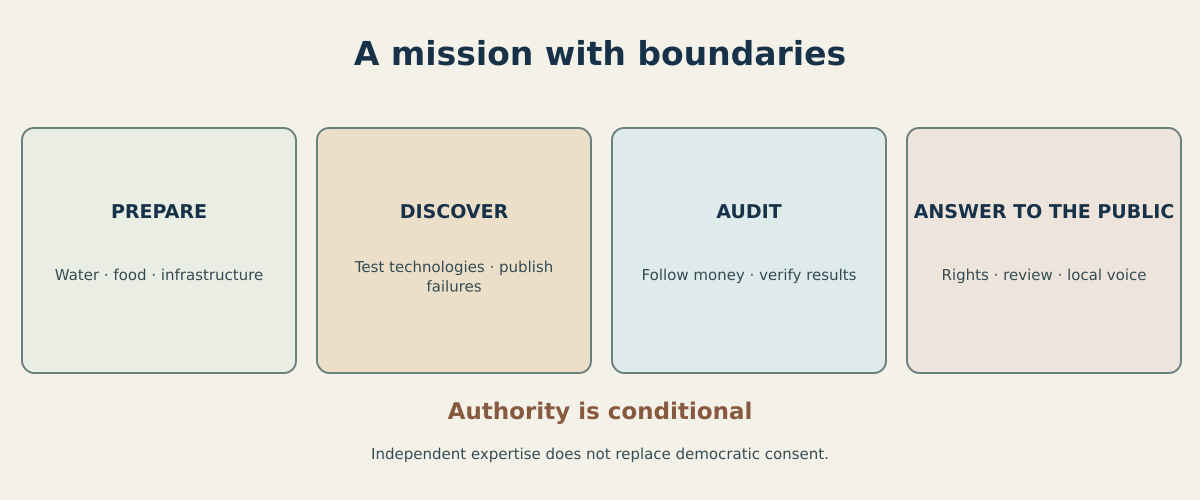
I do not want another institution producing elegant targets for someone else to miss. I want teams that can specify a water project, procure the equipment, publish its cost, measure whether it works and explain what went wrong when it doesn't.
Where does the money come from?
The obvious answer is to stop pretending that long-term protection can be financed entirely by occasional promises from ministers whose budgets change every year.
Consider international shipping. A small charge on a global commercial activity could create a continuing international revenue stream. The fact that shipping crosses borders is a practical reason to negotiate a common mechanism rather than a reason to abandon the idea. An emissions-linked charge could also encourage cleaner fuels, although the detail would matter enormously: which ships, which emissions, who pays and who receives the money?
This is not merely an idea invented over dinner. The International Maritime Organization has been negotiating a net-zero framework involving standards and economic measures. Its draft framework was approved at committee level in April 2025, but formal adoption was delayed; as of October 2026 the next extraordinary session was being prepared for December. It is not an enacted global climate levy handing money to my hypothetical team.[9]
I would rather begin with that honest distinction than manufacture a wonderful revenue forecast from a made-up tax rate. The sums would need to be modelled using measured shipping fuel use and emissions, trade patterns, price effects and the costs borne by import-dependent countries. A badly designed levy could punish precisely the coastal and island societies it ought to help.
And money can disappear. I have little faith in writing cheques to governments and hoping they arrive at a village water supply instead of somebody's bank account. That does not mean the village should be abandoned. It means funding must follow projects, equipment, independently verified milestones and published accounts. Contractors, beneficiaries and auditors should not be the same people.
My proposal is not to substitute one enormous unaccountable pot of money for a dozen smaller ones.
The problem with the word 'genius'
This is where I need to argue against my own enthusiasm. Talented people can be catastrophically wrong. An engineer may be brilliant at engines and ignorant of a farming community's needs. A celebrated entrepreneur may be excellent at raising capital and terrible at admitting failure. A scientist may describe the risks accurately without having the authority to decide which sacrifices are fair.
We know how dangerous it is to let expertise become an excuse for power without consent. Technical competence cannot settle whose land is moved behind a flood barrier, who loses a job or whether an experimental intervention is acceptable. Those are political and moral choices.
An independent body therefore needs a constitution, not a cult of personality. Publish its objectives, spending and contracts. Give affected communities a formal voice. Require external audit, conflict-of-interest rules and a right to challenge decisions. Give researchers room to work while preventing financiers from quietly purchasing the conclusions. Make appointments time-limited; make failures visible; keep law-making and coercive powers within legitimate democratic institutions.
Britain's Climate Change Committee illustrates a useful division: independent expertise can scrutinise government and advise on carbon budgets, while elected bodies remain responsible for political decisions.[3:1] I would go further on delivery and financing, not remove the duty to answer to the people affected.
The hard question is not whether we can find clever people. It is whether we can build an institution that stays useful when the clever people disagree, leave, disappoint us or become enamoured of their own importance.
Science can say what works; people must decide what is fair
A wealthy coastal city may be able to build barriers. A small community may have to move. Which project receives funding first? Who pays for people to leave a place their grandparents inhabited? What happens when a technology lowers emissions but damages an ecosystem? A room full of specialists cannot produce a morally neutral answer merely by adding more equations.
I do not want politicians to vanish. I want them to stop treating technical delivery as an extension of campaigning. Let public institutions decide rights, constraints and obligations; let independent specialists propose and execute verifiable programmes within those limits; let communities contest the consequences. That division is not perfectly tidy. It is preferable to concentrating the entire problem in a press conference.
And notice that a credible programme would not need to choose between emissions reductions and preparation as though only one can matter. Every additional increment of warming increases risk, and cutting emissions limits future damage.[1:1] At the same time, water, heat, food and infrastructure hazards already require action.[8:1] Preparing first is a choice of immediate practical emphasis, not an excuse to keep making the long-term problem worse.
An institution measured by things that survive
Imagine that, ten years after a new international mission began, a journalist asked what it had achieved. I would not want the answer to be the number of conferences, declarations, launch events or people following its account.
I would want to know which reservoirs still supply water through a drought; which ports and hospitals have tested backup systems; how many vulnerable homes are safer; which experimental technologies were abandoned and which were adopted; which budgets went missing and who recovered the money. Not every worthwhile result fits a single metric, but every serious programme ought to be able to show its work.
Perhaps the endeavour would fail. Perhaps it would be captured by the same interests it was built to resist. A design that cannot admit those risks has no business being entrusted with extraordinary resources.
What I find harder to defend is the comfortable assumption that the only respectable option is to ask politicians to promise harder next time. We have been doing that for decades. The atmosphere has not noticed our sincerity.
The question in the title is deliberately unfair. People in a democracy do entrust politicians with governing. But governing is not the same thing as possessing the expertise to fix every problem, and no election result can amend the laws of physics.
The future needs more than somebody who can win the next argument. It needs people who can build something that will still be working when the argument, the government and the people who appointed them are long gone.
References
IPCC (2021). Climate Change 2021: The Physical Science Basis, Summary for Policymakers, B.5.3–B.5.4, and IPCC (2023), Climate Change 2023: Synthesis Report, headline statements B.1–B.3. Physical science assessment · Synthesis headlines. ↩︎ ↩︎
UNFCCC. Key aspects of the Paris Agreement, especially Article 4 on nationally determined contributions and five-year progression. Official explanation. ↩︎
UK Parliament (2008). Climate Change Act 2008, especially Part 1 and Part 2; Climate Change Committee, About the CCC. Legislation · Committee remit. ↩︎ ↩︎
UNEP (2025). Emissions Gap Report 2025: Off Target. Current-policy and pledge-contingent temperature estimates are modelled scenarios assessed at publication, not exact forecasts. Report. ↩︎
NASA, A Brief History of NASA, section Going to the Moon — Project Apollo. Original-programme spending figure and Kennedy's May 1961 commitment. NASA history. ↩︎
National Park Service. Manhattan Project National Historical Park: Frequently Asked Questions, on organisation and cost; US Department of Energy, History, on its institutional legacy. NPS history · DOE history. ↩︎
World Health Organization. Smallpox and Smallpox Eradication Programme (1966–1980). WHO overview · Programme history. ↩︎
IPCC (2022). Climate Change 2022: Impacts, Adaptation and Vulnerability, Summary for Policymakers, especially B.2, C.1 and C.2. Assessment. ↩︎ ↩︎
International Maritime Organization (2025–2026). IMO Net-Zero Framework — FAQs and MEPC 84 session summary, recording 2025 approval, delayed adoption and planned December 2026 negotiations. IMO framework · MEPC 84. ↩︎